Alphabet's spinout machine is the new venture fund
Three sovereign wealth funds joined Isomorphic Labs' $2.1bn round on Tuesday, on a cap table only Alphabet could assemble
Isomorphic Labs, the AI-driven drug discovery company spun out of Google DeepMind in 2021, announced on May 12th that it had raised $2.1bn in Series B funding led by Thrive Capital, the New York venture firm that led OpenAI's $6.6bn Series E in October 2024 and now manages more than $50bn in assets. The round drew commitments from MGX, the Abu Dhabi-backed AI investment vehicle, Temasek, Singapore's state investment company, and the UK Sovereign AI Fund, and ranks as the second-largest biotech financing in history. Only Altos Labs, the cellular-rejuvenation biotech that emerged in 2022 with $3bn at launch, sits above it. Alphabet and its two venture arms, GV and CapitalG, participated.
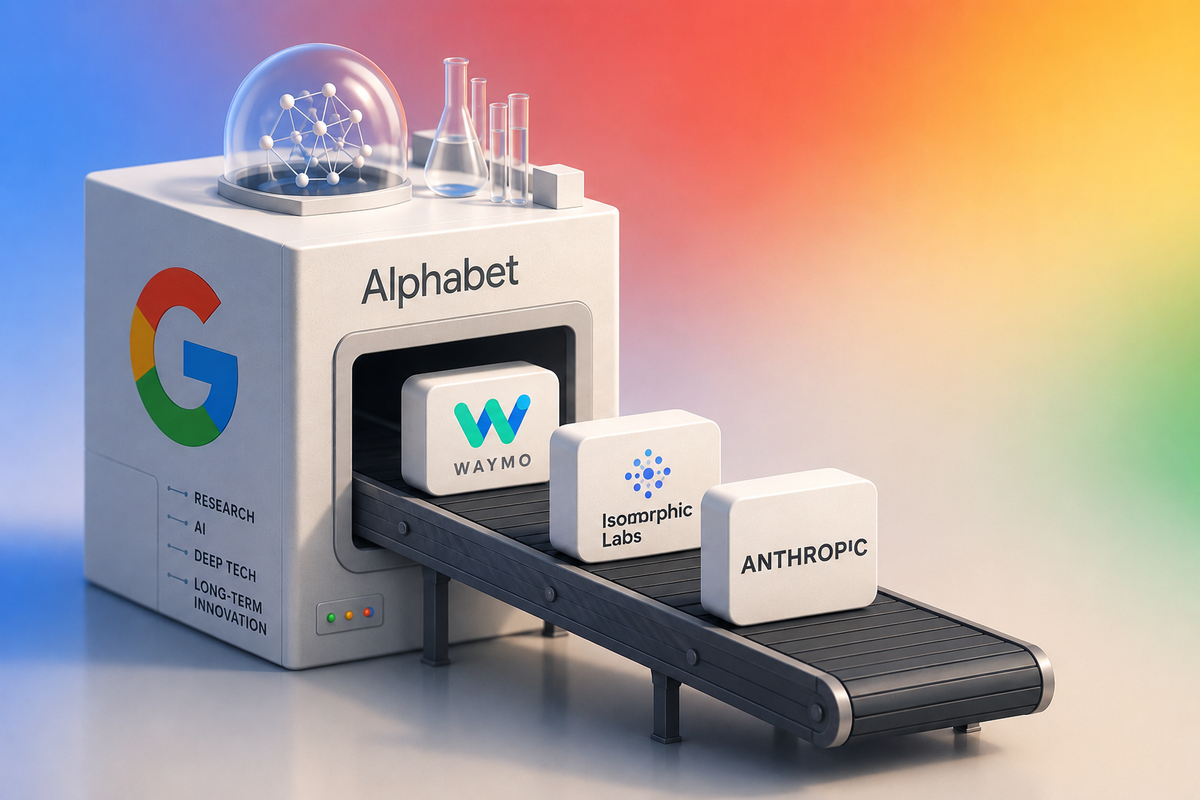
Set against Waymo's $16bn round in February, which closed at a $126bn valuation — nearly tripling the autonomous-driving unit's $45bn mark from October 2024 — the picture firms up. Alphabet remains Waymo's majority shareholder, Isomorphic's largest shareholder, and a multibillion-dollar holder of Anthropic, the AI lab whose Claude models compete directly with Google's Gemini; add the company's 6.11% position in SpaceX, disclosed in an Alaska regulatory filing last month, and what emerges is something larger than a portfolio. It is a fund.
Cap and trade

The architecture does not yet have a name. A traditional venture firm raises capital from limited partners, deploys it on a clock, and returns the proceeds within a decade; Alphabet does none of that. It funds research inside the parent company on its own P&L for as long as it wants — AlphaFold, the protein-folding system that won Demis Hassabis, who runs both DeepMind and Isomorphic, a Nobel Prize in chemistry in 2024, was an internal R&D project for five years before Isomorphic was carved out — and then spins the result into a separate legal entity that raises external capital at private-market marks. The parent keeps majority ownership; the operating losses sit on the spinout's P&L; the mark-to-market upside flows back to Alphabet shareholders through the carrying value of the equity stake.
This article is for Vector members. Start a 7-day free trial to keep reading.
Start your free trial