Apple rents the brain, keeps the moat
The revamped Siri is two years late, on a rival's model, and somehow holding the only card that matters
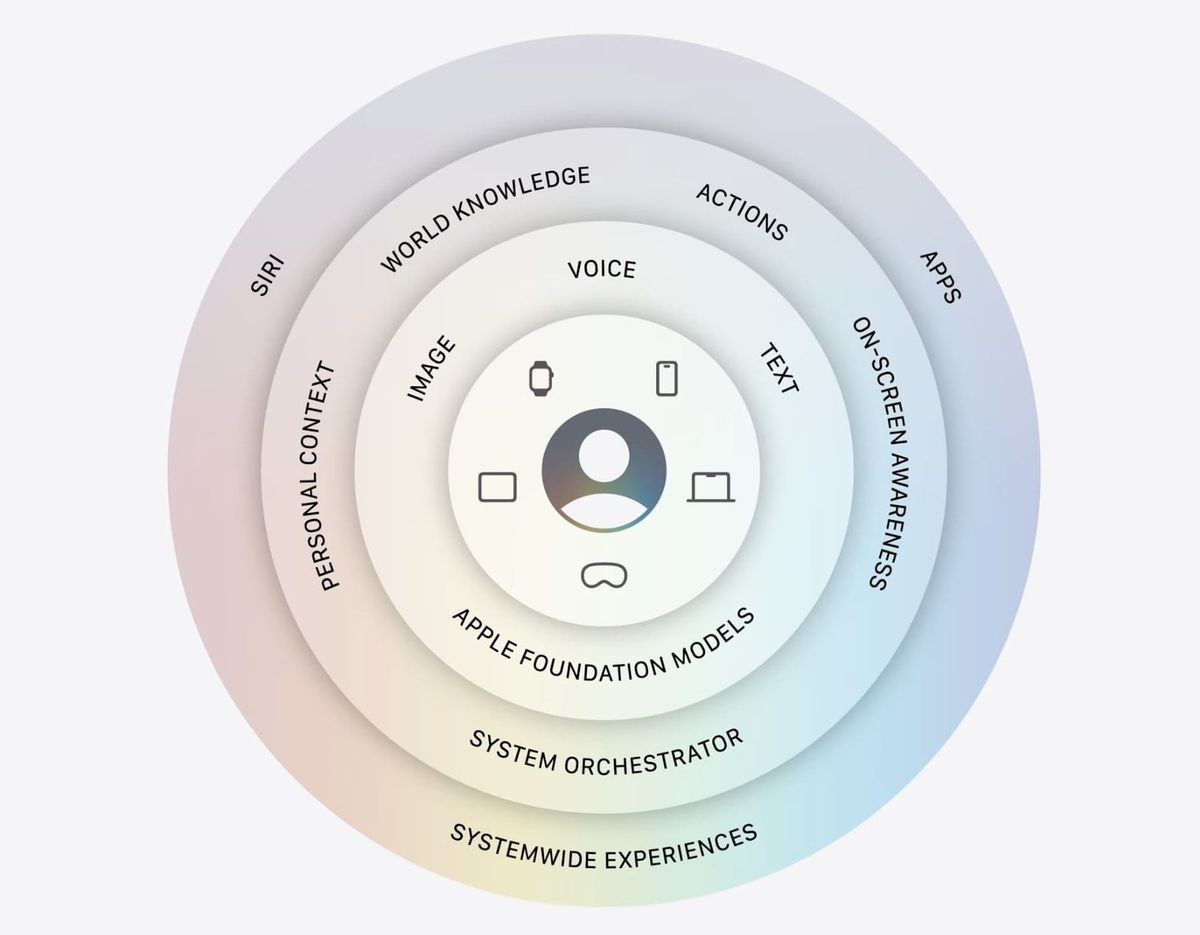
On stage at Apple Park on Monday, Siri was handed a small, ordinary errand: a route to a place caught in an on-screen photo, with a stop at a friend's house on the way. The friend's address was nowhere in the contacts. It sat in an old, unsaved message, the kind that accumulates by the thousand in everyone's phone. Siri found it, lifted it, and built the route, three actions inside a single spoken sentence and not an app opened.
That errand is the entire argument Apple spent two years failing to make. The assistant it unveiled on Monday, rebranded Siri AI, reads what is on the screen, holds a back-and-forth conversation, answers from the open web, and reaches across Messages, Mail, Photos and Calendar to act on what it finds. None of this is novel as a capability; ChatGPT and Anthropic's Claude have done versions of it for longer, and on the benchmarks they reason better. What they cannot do is the errand Siri ran on stage, because a third-party app cannot read the unsaved address in your texts; it cannot see your texts at all. It waits in a sandbox for you to carry the context in to it by hand, prompt by pasted prompt.
Local knowledge
This is the asset the assistant race has been mispricing. For two years the scoreboard has been model quality — benchmark scores, reasoning, the size of a context window — and on it Apple has been a punchline. It announced Apple Intelligence in June 2024, demoed a personalized Siri it could not ship, delayed the features into 2025, delayed them again, and last month agreed to pay $250m to settle a class action brought by customers who had bought iPhones on the promise of a Siri that did not yet exist. Monday's keynote was, in plain terms, the delivery of the product Apple had been sued for advertising.
Yet the benchmark was always measuring the wrong axis. An assistant that drafts a sonnet is a parlor trick; an assistant that knows which Jeff you mean, because it can see the standing Thursday dinner in your calendar, is a utility. The first needs a cleverer model; the second needs privileged access to the messy, private, un-API'd record of a person's life, which lives behind the operating system. Two companies own the gateway to it at consumer scale: Apple, with more than a billion active iPhones, and Google, which is making Gemini the default assistant across Android. The labs with the cleverest models do not own a phone; they rent space on someone else's.
This is the structural reason OpenAI has bought a hardware startup and shipped its own browser, reaching for any surface that would put it on the user's side of the sandbox wall. Sam Altman, OpenAI's boss, has chased that gateway precisely because he understands an asymmetry the benchmark coverage keeps missing. Distribution and default placement have settled consumer-technology fights before, and they are rarely won by the better engine. They are won by whoever the user already carries in a pocket.
The complication, and it is a real one, is that Apple's new brain is also Google's. Siri AI runs on a custom version of Gemini under a partnership struck earlier this year, which leaves the company now selling privacy as its chief differentiator having outsourced the reasoning to the firm whose business is built on data. Apple's reply is architectural: the model runs on-device or inside what it calls Private Cloud Compute, and Craig Federighi, Apple's software chief, told the audience that privacy in AI was "non-negotiable" and that outside experts could verify the claim at any time. Whether it holds is a question for the security researchers rather than the keynote, but the strategic logic survives either way. Apple has rented the part of the stack that can be rented, the model, and kept the part that cannot, the context.
None of this makes the lost years imaginary. Two years is a long time in a fast market; the new Siri still ships in beta, in English, and not at all in the European Union or China; and renting your core intelligence from your single most dangerous rival is a dependency, not a victory. But the story everyone told about those years, that Apple had missed the AI wave and might never catch it, mistook a slow product for a weak position.
What makes an assistant indispensable was never the cleverness; it was the standing permission to look inside the phone, and Apple has held that permission since 2011, when Siri first shipped as a novelty that could set a timer and not much else. The model can be bought from Google. The text from your mom cannot.