Google quietly captures the AI trust layer
As OpenAI ships an image verifier and YouTube ships auto-labels, both run on Google's invisible watermark
The site, when it loaded for the first time on Wednesday morning, looked almost defiantly plain: a single upload box, a two-second processing pause, and then a verdict. The site is openai.com/verify, the public verification tool OpenAI quietly turned on this week as part of its 2026 election safeguards rollout, and it lets anyone drop in an image and learn whether ChatGPT produced it. The verifier checks for one of two signals: a metadata trail attached to the file by an open industry standard called C2PA, or an invisible watermark baked into the image's pixels by a system called SynthID. The first belongs to a non-profit standards body. The second belongs to Google.
OpenAI's verifier was the headline item in a 2026 election safeguards rollout the company announced on Wednesday morning, and it was not the only AI-detection arrival that day. Two hours earlier, YouTube, the video platform owned by Alphabet, posted a blog announcing that its software would now decide, without asking creators, whether a clip viewers were watching had been significantly produced by artificial intelligence, and apply a label directly under the player. Both announcements landed eight days after Google itself, at its I/O developer conference on May 19th, said that AI-content detection would be coming natively to Chrome, Google's browser, and Google Search, the world's most-used information utility. The three announcements, taken together, mark the arrival of a real AI-detection regime in the largest American consumer products on the internet — the long-promised, long-delayed answer to the question that has hung over every American election cycle since GPT-3.
Independent studies have repeatedly found that ordinary viewers cannot reliably distinguish AI-generated images from real ones, often performing at little better than chance. The volume of deepfake videos circulating online rose roughly 550% between 2019 and 2024 by one widely-cited estimate from a vendor that sells detection software. Whatever else this regime ends up being, it is overdue. In 2024, the major AI labs and platforms signed an "AI Elections Accord" in Munich pledging to develop content provenance and detection. Most of what was promised did not ship in time for that election; most of what is shipping now is shipping ahead of the next one.
Signature move
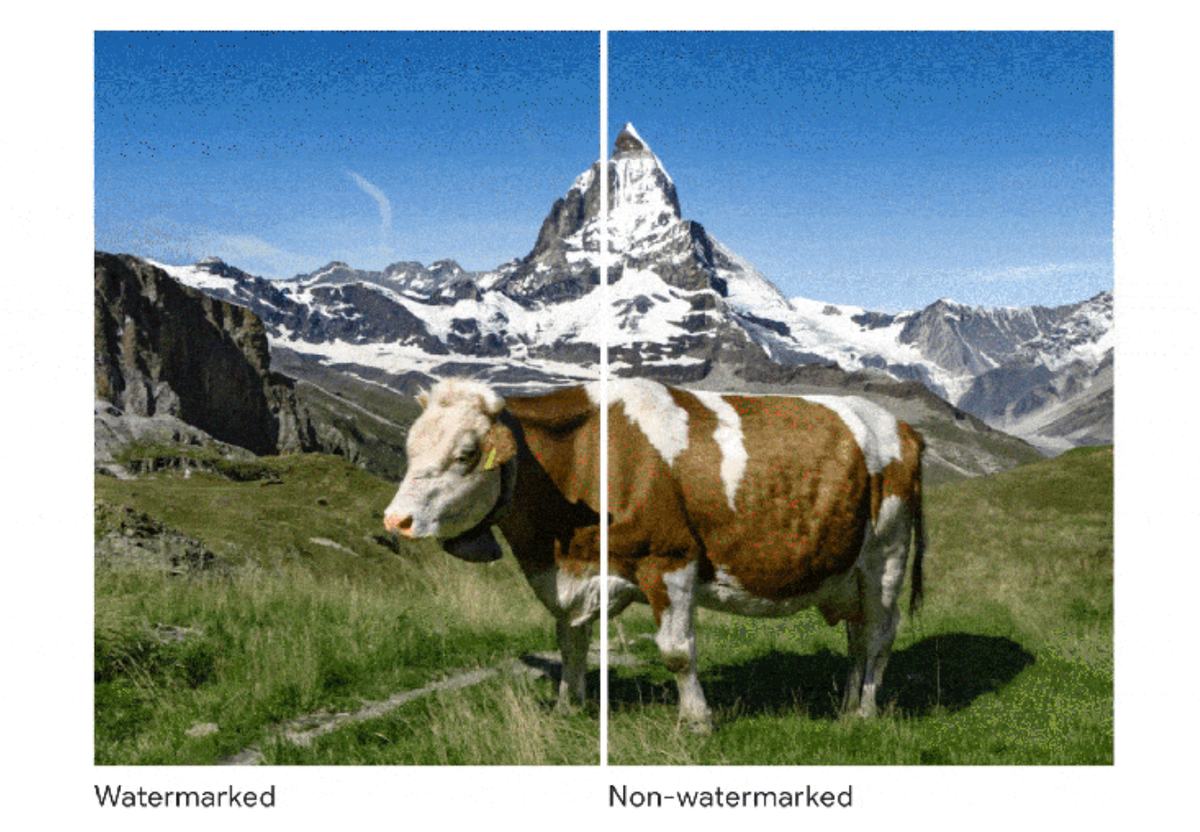
On May 19th, the two systems doing the work in OpenAI's verifier both got a major push. Google announced that it had spent three years quietly baking an invisible watermark, SynthID, into the pixels and audio samples of every image, video, and song produced by its AI tools. The mark is undetectable to humans but legible to the right software; Google reported having applied it to more than 100 billion images and videos. The watermark survives common modifications — cropping, compression, screenshots — that strip ordinary metadata. It is, by design, durable.
The other piece of the stack is older and more familiar. The Coalition for Content Provenance and Authenticity, or C2PA, is an open industry standard launched in 2021 by Adobe, Microsoft, Intel, Arm, the BBC, and Truepic. It attaches a cryptographically-signed digital paper trail to a file — a manifest recording where the file came from, what tools touched it, and what edits were made. The standard is open, ratified by the International Organization for Standardization, and signed by hundreds of newsrooms, camera-makers, and software vendors. Where SynthID is a watermark, C2PA is a paper trail. Where SynthID survives a screenshot, C2PA does not.
On the same May 19th, OpenAI joined the C2PA steering committee and committed to embedding SynthID into ChatGPT's image outputs alongside the Content Credentials it had already begun attaching. The companies announced the moves the same morning. Read together, the announcements were a tacit standards alignment: the labs would pair the rich-but-fragile C2PA manifest with the durable-but-impoverished SynthID watermark, giving the detection stack two layers — one open, one Google's.
YouTube's Wednesday announcement filled in the consumer-facing side. The platform will now auto-apply an AI label to videos its internal classifier flags as significantly AI-generated, and the label will become permanent for content carrying C2PA metadata marking it as fully synthetic. Labels will not affect recommendations or monetization, the company said, an arrangement that drew no objection from Wall Street and quiet relief from creators. OpenAI's verifier, openai.com/verify, will at launch check only content OpenAI itself produced; cross-industry verification, where the site could rule on a Midjourney or Anthropic image, is on the roadmap and conditional on those labs adopting compatible standards. Google's own browser and search products will surface AI-detection signals natively, on every page, by default. The three arrivals together cover generation, distribution, and verification — the full chain from where AI content is made to where it is read.
The same vendor sits underneath all three. SynthID is Google's. The detector model that confirms a SynthID watermark is Google's, and the watermark specification is not open-source, meaning no third-party developer can implement SynthID detection independently. OpenAI's verifier, in the cases where C2PA metadata has been stripped from an image but the watermark survives, is calling Google's detector to get its answer. YouTube's parent company is Google. The standards layer in the picture, the cryptographic manifest layer, is C2PA, which is open and ISO-ratified and supported by Adobe, Microsoft, Intel, and a long list of newsrooms. The durability layer underneath C2PA — the invisible signal that survives the screenshot and the re-upload — is proprietary and Google-owned. What looks, at the press-release altitude, like a cross-industry commitment to provenance is, on inspection, a Google standard wearing an open-source bow.
This is not the first time the trust layer of the internet has gone private. The system that lets browsers verify a website's identity, the SSL/TLS certificate authority infrastructure, has been operated since the 1990s by a small number of commercial firms whose names — VeriSign, DigiCert, Let's Encrypt — most users have never heard, but whose continued operation the entire encrypted internet depends on. The certificate authorities are, in effect, the gatekeepers of online identity. They are also a known concentration risk; the compromise of DigiNotar, a Dutch CA, in 2011 led to the company's bankruptcy within weeks and to a quiet acknowledgement, across the industry, that the model had a single point of failure. SynthID is a younger and narrower piece of infrastructure, but it is being asked to do work of the same kind: a quiet, invisible authority that operates underneath the consumer experience and confers a kind of legitimacy on everything that carries its signal.
The race to standardize has a deadline. On August 2nd, the EU's AI Act takes full effect, and every company offering AI tools in Europe will be required to mark AI-generated content. Violations carry fines of up to 3% of global annual revenue, or €15 million, whichever is higher. Brussels, in line with the Act's general technology-neutral posture, has not specified which technical method satisfies the rule. The European Commission's own draft Article 50 guidelines, published in May, treat both C2PA and SynthID as examples without endorsing either. The labs are picking one before the regulators do.
What ships in May is the easy part. YouTube's labels do not affect distribution or monetization, and OpenAI's verifier returns a signal rather than a takedown; neither system is a gate, and neither was designed to be one. The harder question, which arrives in August under the EU mandate and again in November under American midterm pressure, is what platforms become obligated to do with the signal once it has been detected. Whether labels become friction, demotion, or removal will be settled later, by regulators and by courts. The question being settled now is one rung lower than that, and quieter: it is the question of whose watermark the rest of the industry runs on, and so far the answer, in the products that ship and the standards that get signed, is Google's. The trust layer of the internet is being built in real time, in standards meetings and product announcements that look procedural, by a company that is also one of the largest distributors of the very content the system is meant to verify.