Harvey builds its moat on rented ground
The legal-AI leader trained its first in-house model on a Chinese open-weight base — trading one dependence for another
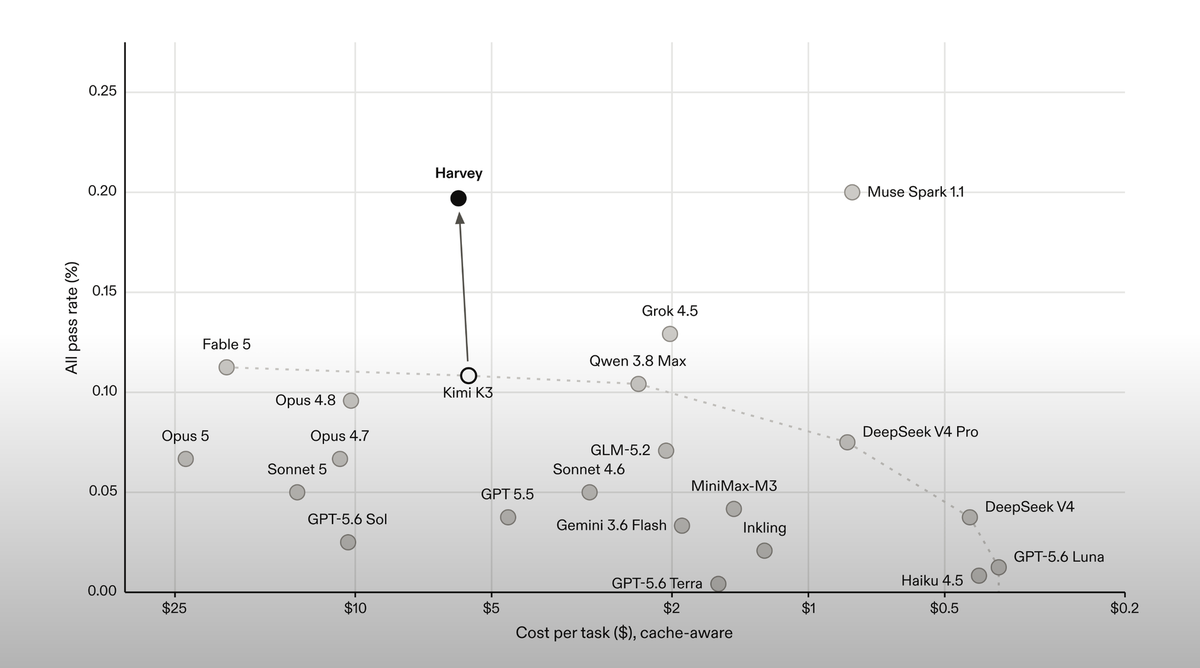
Harvey, the most valuable company in legal AI, just released the first model it can call its own. This is a firm founded on other people’s models. It is among the earliest and most celebrated bets of the OpenAI Startup Fund, and for three years it made its name doing one thing well: taking the closed frontier systems of OpenAI, Anthropic and Google and bending them to the peculiar demands of contracts, case law and the low tolerance for invented citations that separates a court filing from a chatbot answer. The model it finally built for itself, called Tenet, was post-trained not on any of those American systems but on Kimi K3, an open-weight base from Moonshot AI, a Chinese lab.
That detail carries more of the story than the launch did. Harvey worked with Fireworks AI, a training platform, and layered reinforcement learning over synthetic data, public legal text and the work of human experts to produce a model it claims reaches the front rank on complex legal tasks. Two months earlier, Gabe Pereyra, Harvey’s co-founder and president and a former large-language-model researcher at Google Brain and Meta, had announced the plan on X in the language of ascent: Harvey would build its own foundation-model series and, in time, let law firms train specialised models on their own data and “own their intelligence.”
This article is for Vector members. Start a 7-day free trial to keep reading.
Start your free trial