
Mayo Clinic gets a frontier model
Mayo Clinic owns the new model outright, yet it reaches other hospitals only through Microsoft's cloud, where the revenue recurs.
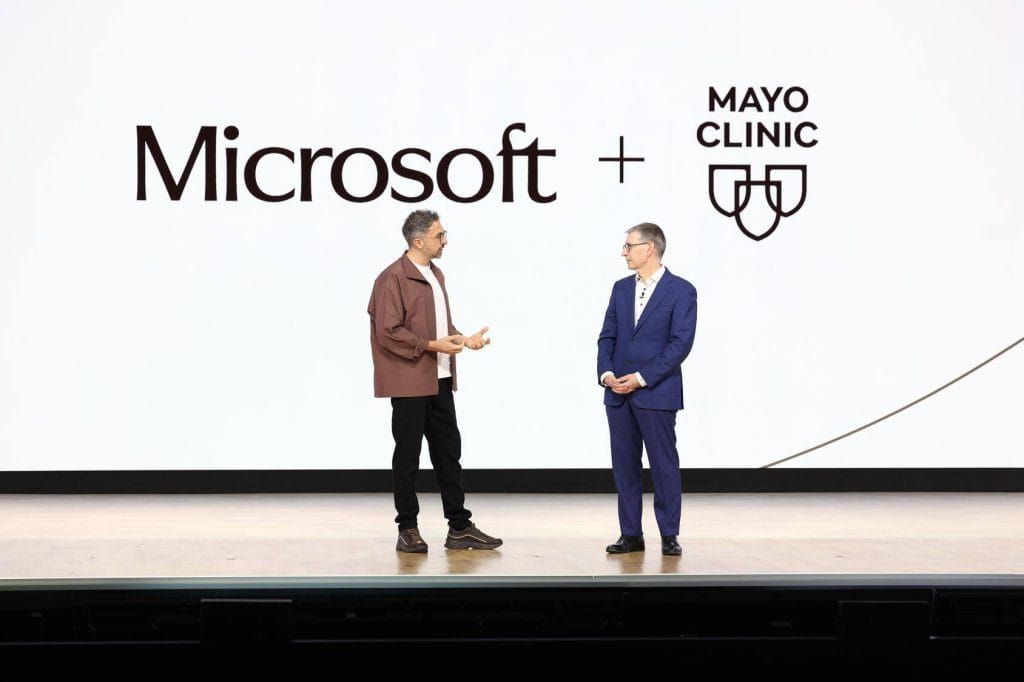
"The frontier AI model will be owned by Mayo Clinic." The sentence runs, word for word, through Mayo's press release, through Microsoft's newsroom post, and through the blog that Mustafa Suleyman, Microsoft AI's chief executive, published on June 2nd to announce the collaboration. It was the line nearly every account of the deal led with, and it is being read as the prize: the hospital that pioneered the patient record, rather than the software giant bankrolling the compute, will hold title to the medical model the two are building. Read a second time, against the distribution arrangement underneath it, the clause looks less like Mayo's victory than like the part of the deal Microsoft had the least reason to keep.
What the two organizations announced is ambitious by any measure. They are co-developing a "frontier" healthcare model — Suleyman's word for a system meant to match the broadest range of clinical reasoning, trained on Mayo's de-identified patient records and longitudinal insights rather than the open internet that makes general chatbots so unreliable on medicine. Gianrico Farrugia, Mayo's president and chief executive, framed it as the culmination of a seven-year effort to turn the clinic into a platform. The model will run inside Mayo's own hospitals first and then, once validated, reach other health systems through Azure Foundry, Microsoft's marketplace for AI models. Neither side would put a figure on the spending, though Suleyman said both were making "very material, long-term commitments."
Rent, not royalties
Neither side disclosed how the money will move, but the channel they named tells most of the story. Models offered to outside customers through Azure Foundry are sold as Azure Marketplace listings, and every one of them, whoever owns the weights, runs on Microsoft's cloud and bills Microsoft's compute meter on each call. That is the architecture the Mayo model will ship inside. A hospital in Houston or Hamburg that licenses it pays for the model and, separately, for the Azure compute that answers every query — input tokens and output tokens, metered per call, for as long as the tool is used. Mayo's cut is a royalty, capped by what the market will pay for access; Microsoft's is rent on the ground the model is built on, and rent compounds with every clinician who ever opens it.
Mayo has run this arrangement before, with a different landlord. In September 2019 it signed a ten-year partnership with Google, storing 1.2m patient records in a "data under glass" enclave where Google supplied the cloud but could not independently reach the data, because Mayo held the key. The constant across both deals is the hospital keeping its scarce asset and renting the hyperscaler's infrastructure to exploit it. The variable is the hyperscaler. Google held the contract in 2019; Microsoft holds it in 2026; the asset never moved. A data owner can change clouds the way a tenant changes apartments, which is precisely why the cloud, not the data, is the position worth holding — whoever owns the rail captures the meter regardless of whose name is on the lease.
This is an old pattern wearing new clothes. Mayo pioneered the unified patient record more than a century ago and has spent the years since turning clinical encounters into a proprietary corpus no rival can assemble; owning that data, and now a model distilled from it, was always the strategy. The layer Microsoft kept is the one that, in every prior computing wave, quietly out-earned the thing riding on top of it. The operating system outlasted the applications. The cloud outlasted the software. Distribution has always pooled the durable money, and a metered API call is distribution in its purest form.
Microsoft's behavior on the same day made the logic explicit. Alongside the Mayo announcement it released seven of its own MAI models, trained from scratch and co-designed with its in-house Maia silicon, with Suleyman insisting there are "no shortcuts to the frontier." A company training its own frontier models while hosting a partner's does not need to own anyone's weights to win; it needs every model — its own, Mayo's, Anthropic's, OpenAI's, all of which already sit in the same catalog — to run on its cloud. Ownership of any single model is a line item; ownership of the substrate they all share is the business.
There is a second reason a software company might prefer the hospital's name on a model that dispenses medical advice. The legal exposure of AI health guidance is no longer hypothetical: in May, parents sued OpenAI over a chatbot's medical advice they blame for their son's fatal overdose, and the consumer health assistants now shipping from Google, OpenAI and Anthropic carry tort risk no one has yet priced. Suleyman expects "many years" before the Mayo model can be trusted for high-stakes consumer use. Until then, and probably after, Mayo will hold the title — and the malpractice question attached to it — while Microsoft holds the meter and none of the liability.
Mayo Clinic will own the model. Microsoft will own the rail it travels on, the compute it burns, and the invoice that lands every time a doctor in another city asks it a question. One of those is an asset. The other is an annuity.