OpenAI's "once-in-a-decade" browser only got three weeks
ChatGPT Atlas was on 1.7% of corporate Macs within three weeks of launch. Five months later, it still hasn't shipped on a second platform.
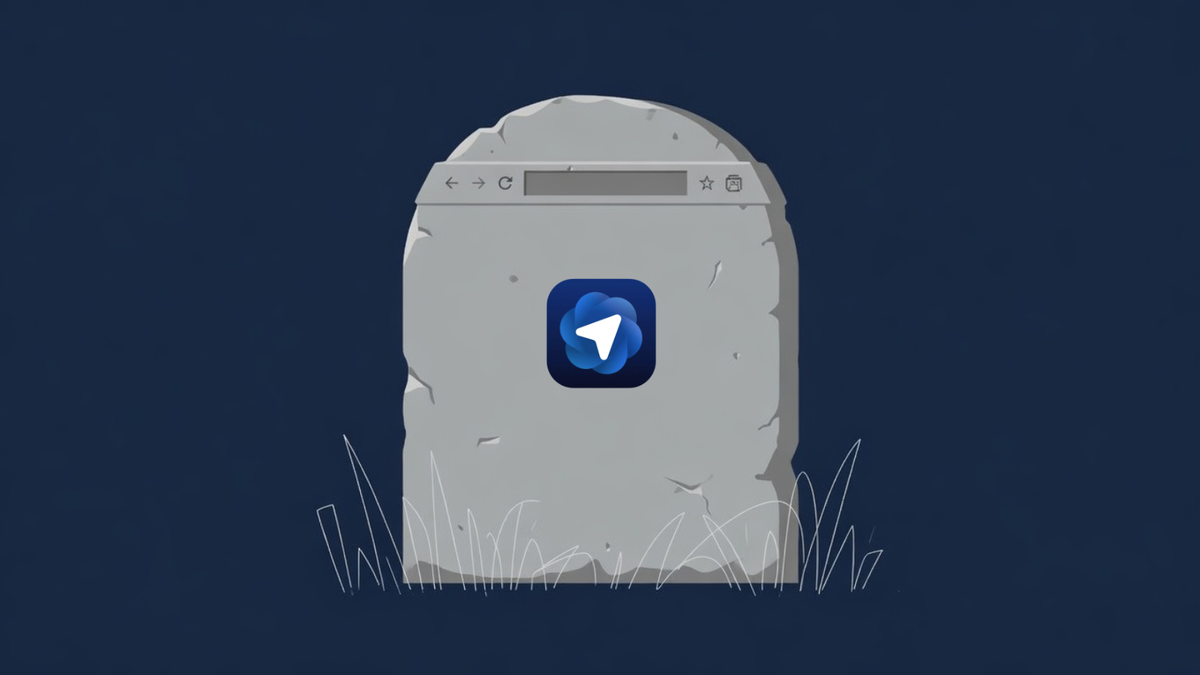
ONCE-IN-A-DECADE was the phrase Sam Altman reached for on October 21, 2025, launching ChatGPT Atlas as OpenAI's answer to the question of what a browser built from the ground up for AI would look like. The pitch was unambiguous: Chrome was a relic, the address bar an anachronism, and the rare opportunity to rethink what it meant to use the web had arrived. Google's market capitalization shed roughly $100 billion that afternoon on the theory that the pitch was correct. Less than six months later, Atlas is being quietly folded into a desktop application alongside ChatGPT and Codex, according to a March 19 internal memo from Fidji Simo, OpenAI's new CEO of Applications. The word "browser" does not appear in the reorg framing. The once-in-a-decade opportunity has been reclassified as a subcomponent.
The context is a broader purge. Simo has been moving through OpenAI's consumer portfolio with a clipboard, cancelling what she has called "side quests." Sora, the video app, was shut down on March 24 after burning compute at rates Forbes and Cantor Fitzgerald analysts estimated as high as $15 million a day against roughly $2.1 million in total lifetime revenue. The adult-mode initiative has been shelved. The $1 billion Disney character-licensing partnership died on the vine. The pattern is consistent: anything that doesn't directly feed enterprise productivity, the coding stack, or the core ChatGPT business is getting absorbed, deprioritized, or killed outright. The main quest is Codex, ChatGPT for work, and API-side agentic tooling sold to Fortune 500 IT. Atlas is now part of that main quest, not its own thing.
Three great weeks
Here is the part that makes the demotion strange. Atlas did not fail on launch — it did precisely what OpenAI's distribution apparatus should have made it do. In the three weeks after Atlas shipped, Cyberhaven Labs, which monitors corporate endpoints at its enterprise customers, reported that Atlas had installed on 1.7% of all corporate macOS devices it tracked. Seventeen out of every thousand enterprise Macs, on a product with a three-week runway. The sectoral breakdown was a napkin sketch of OpenAI's target user: 67% of installs in technology, 50% in pharmaceuticals, 40% in finance. Cyberhaven found at least one Atlas install at 27.7% of the enterprises in its sample, and at some firms the unsanctioned install rate reached 10% of total headcount. By Cyberhaven's count, Atlas racked up 62 times more corporate downloads than Perplexity's Comet in the same window.
This article is for Vector members. Start a 7-day free trial to keep reading.
Start your free trial