Blue Origin's first round, courtesy of SpaceX
Bezos backed Blue Origin alone for 26 years — the first outside round arrives just as SpaceX lists
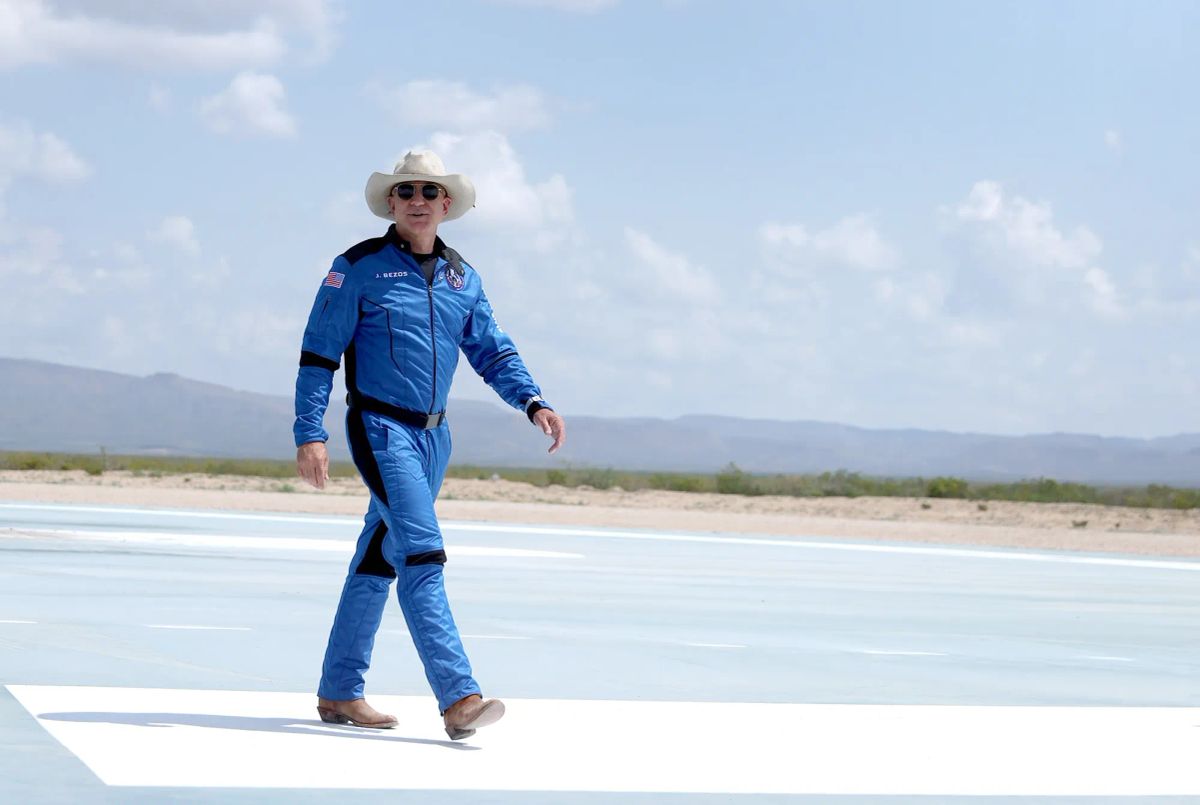
Jeff Bezos has been Blue Origin's only investor for twenty-six years. The rocket maker has burned roughly $28 billion of its founder's Amazon proceeds since its incorporation in 2000, according to Capstone, a Washington-based consulting firm, and is on track to spend a further $4.8 billion in 2026. At an all-hands meeting this month, Dave Limp, the former Amazon hardware executive who took the chief executive job in late 2023, told staff that the model had reached its limit. The company, Mr Limp said, would need to "be ready for external funding."
The proximate cause is ambition outrunning the wallet. Blue Origin is building an 800,000-square-foot manufacturing facility in Florida, standing up a second launch pad, and developing a reusable upper stage. Mr Limp has set a long-term cadence target of 100 launches a year, a significant portion of them in service of TeraWave, the satellite-communications constellation Mr Bezos plans to sell to business customers. The Financial Times, which broke the story, framed the round as the price of those ambitions — a confession that one man's wealth, however vast, cannot underwrite an industrial launch business indefinitely.
But the round's timing reaches for a different explanation. In the coming weeks, on June 12th, SpaceX will list on the Nasdaq, raising up to $75 billion at a valuation of $1.75 trillion. It will be the largest initial public offering in history — nearly three times the size of Saudi Aramco's 2019 listing, which itself raised $25.6 billion and was, at the time, the largest IPO ever priced. Roughly 4% of SpaceX's shares will be made available in the offering. The rest of the demand will go somewhere.
Wake-riding
That somewhere, for the cohort of institutional investors who have spent the past three years building positions in pre-IPO SpaceX through secondaries on Hiive, Forge Global, and EquityZen, will be space-adjacent assets they can still buy at private-market prices. Blue Origin is the only one of any scale; small parcels of its stock already change hands on Hiive, but without an anchor round, no one quite knows what to pay. Analysts have placed Blue Origin's enterprise value somewhere between $50 billion and $100 billion, a span whose width is itself a confession that no recent round exists to set a number against. Scottish Mortgage, the British investment trust whose SpaceX and Tesla positions have made it the most-watched listed proxy for Silicon Valley unicorns, marks SpaceX at $1.25 trillion as of March. A first external Blue Origin round, struck in the weeks around SpaceX's IPO, would set Blue Origin's number for the first time in the company's existence — and would do so in a window during which the comparable for space launch is about to be repriced upward in public by a factor of five or six.
Mr Limp's framing of the round is consistent with this read. He told staff that external funding was "one option on the table" and that the company would have to "demonstrate strong economics." He invoked OpenAI and SpaceX explicitly, suggesting that fundraising rounds could double as a mechanism to allow employees to exercise stock options without an IPO. The new option plan, he said, had been "written intentionally to allow for that." It is the playbook of the new mega-private company: periodic tender offers and primary rounds, structured to provide liquidity without subjecting the company to public-market discipline. OpenAI has run it for two years. SpaceX has run it for longer.
The model has become the default for capital-intensive frontier companies that have outgrown conventional venture. But it requires something Blue Origin has never had — a price. Until now, Mr Bezos has been the company's price-setter by virtue of being its only shareholder. The instant a second investor writes a check, Blue Origin acquires a valuation in the way SpaceX acquired one when Baillie Gifford led its Series J in 2019, and from that point the company's burn rate becomes legible to people who did not sign up for it.
Mr Bezos appears to have decided the trade is worth it. He has been Blue Origin's patient capital for a generation, and the patience has been increasingly visible. The company has flown New Glenn just three times since the heavy-lift rocket first reached orbit in January 2025; SpaceX, in the same period, flew Falcon 9 more than 230 times. The third New Glenn flight, in April, lost an AST SpaceMobile satellite to an upper-stage anomaly, and the vehicle is currently grounded. Mr Bezos owns roughly 9% of Amazon by recent proxy filings, down from 14.1% when he stepped down as chief executive in 2021, and some portion of every percentage point sold has flowed into Kent, Washington, where Blue Origin keeps its headquarters. At $4.8 billion of annual burn, the opportunity cost of funding the rocket maker out of Amazon stock has stopped being invisible.
The June 12th IPO will not fix Blue Origin's cadence. Nor will the round that follows it. But the round will set a price, give employees liquidity, broaden the cap table, and — most importantly — happen in the only four-week window for the next decade in which space-launch comparables will be revalued in public by an order of magnitude. Mr Bezos spent twenty-six years choosing not to take outside money. He chose four weeks to start.