The shot heard 'round the defense-tech world
Three Saronic drone boats sank an Iranian submarine this week. The same cheapness that reprices the company lowers the bar to war.
For most of the age of sail, the weaker naval powers kept a cheap way to fight the stronger ones. A government issued a letter of marque, and a privately owned ship became a legal instrument of the state, its owner entitled to a share of whatever he seized. It was sea power bought off the books, and it let second-rank navies bleed fleets they could never have met in a line of battle. Britain, once it ruled the oceans, wanted the practice gone; at the Congress of Paris in 1856 the great European powers duly abolished it, on the reasoning that a sea without privateers belonged to whoever already owned the largest fleet. The United States refused to sign. Lacking a navy of that size, it meant to keep the equalizer.
That was the argument in 1856, and it came back this week in the Strait of Hormuz.
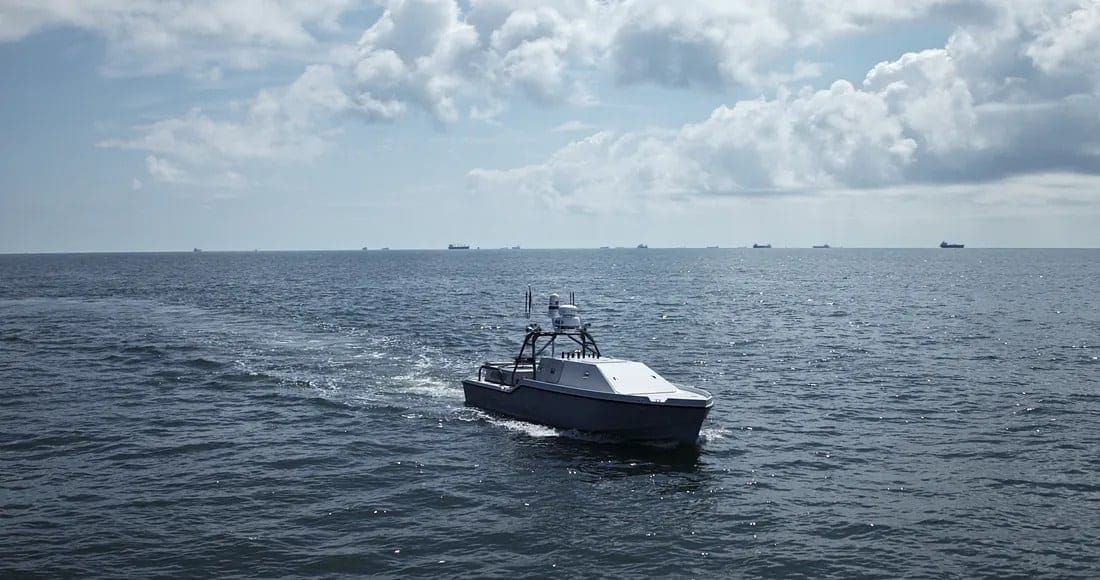
On Sunday three Corsair unmanned surface vessels — 24-foot autonomous boats built by Saronic, a four-year-old firm in Austin — crossed the water at Iran's Bandar Abbas naval base and detonated against a docked Ghadir-class midget submarine and a ship-maintenance yard. The clip U.S. Central Command posted on Monday runs about twenty seconds: the low approach, the submarine hoisted on a yellow gantry, the feed washing white. CENTCOM called it the first time American forces have used sea drones in combat.
American shipyards are slow and dear, and that is the problem the Corsair was built to solve. A guided-missile destroyer runs to the billions and can take the better part of a decade to float, while China now launches hulls faster than the United States can answer. A Corsair costs, by most accounts, under $1m — Sacra, a research firm, puts the platform at $1.2m — carries 1,000 pounds a thousand nautical miles, and is built to come off the line by the hundred and then the thousand. Three of them, perhaps $3m in all, erased a submarine and a repair yard. Saronic has raised some $2.6bn since 2022, most of it in a $1.75bn round in March, led by Kleiner Perkins, a venture firm, at a valuation of $9.25bn, and it holds a $392m Navy production contract that runs to 2031.
A weapons startup can raise on promise and demonstration, but the one thing it cannot manufacture for itself is a kill, and combat validation does for a defense company what a Phase 3 readout does for a drugmaker: a result, on a date, that reprices everything behind it. Saronic's next round will be marked against footage the U.S. government shot and posted on its behalf. The privateer took his pay in captured hulls; his successor takes it in the mark.
Loss leader
The Corsair was designed for precisely this. Saronic built it for Replicator, the Pentagon initiative announced in 2023 to field thousands of cheap, attritable, uncrewed systems within two years, meant above all to offset China's numbers in a war over Taiwan. Bandar Abbas was that program performing to specification — expendable autonomy in the water, fast, and spent. The submarine it destroyed was laid up on a dock, the approach in the video is slow and unopposed, and no American was aboard the boats or anywhere near the risk. Every friction that once turned a strike into a decision — the exposure of one's own people, the price of the platform, the political weight of committing a manned asset — had been engineered out of the thing.
The country has run this experiment already, in the air. As the Predator and the Reaper, America's armed drones, took the pilot out of the cockpit and the risk out of the sortie, the number of strikes climbed, and the restraint that came from risking a life went with it. The cheaper force gets, the more of it gets used. Saronic has now built the naval version and priced it for scale.
In 1856 the United States would not give up the privateer because a lesser naval power cannot fight a greater one by the greater one's rules. At sea it is a lesser power again, outbuilt by China and unable to match it yard for yard, and it has reached once more for cheap and expendable force, this time drawn up in Austin and priced on Sand Hill Road. The market has already marked the upside of that. The other half of it — that a country reaches for force more readily once force is this cheap — is harder to see and impossible to short, and it turns up on no one's cap table.