Nvidia buys the demand it cannot make
Hugging Face's most-downloaded models come from Alibaba, and Nvidia's own filing admits its new purchase depends on them.
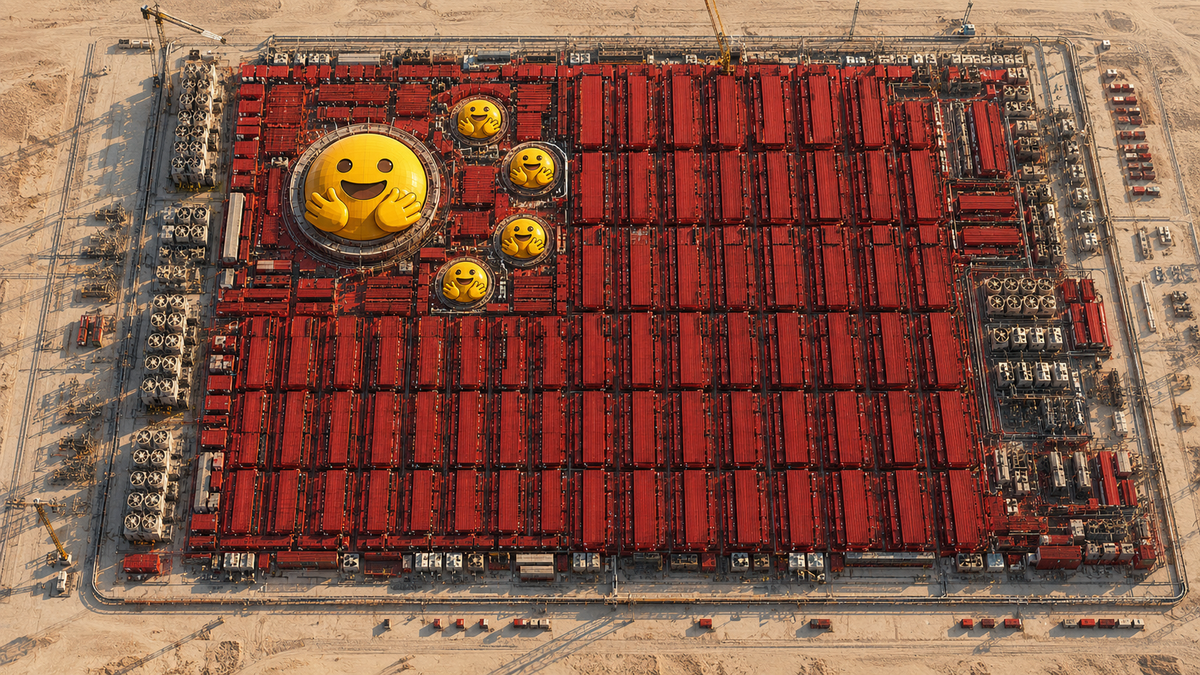
HUGGING FACE is named after an emoji. On September 2nd Nvidia, the world's most valuable company, agreed to pay $12.93bn for it, or roughly 86 times the firm's revenue. That is a lot for a smiley. It is also, at three weeks of the cash Nvidia is expected to throw off this year, the kind of sum Jensen Huang, its boss, can spend without asking anyone.
The logic Mr Huang offers is generous to a fault. Hugging Face, the open-model world's GitHub, will keep its name, its neutrality and its 18m developers. Nvidia's chips will not be required to build on it or deploy from it. The company already contributes more open models to the platform than anyone else. Its blog post reads less like an acquisition and more like an endowment.
Look at the filing, however, and the purchase is plainly defensive. Nvidia's largest customers are designing their way off its chips; open-weight models run on whatever hardware the downloader already owns, which is mostly Nvidia's. Hugging Face is where those downloads happen. Mr Huang has bought the demand side of his own business. The catch, which Nvidia disclosed itself, is that the demand is made in China.
True, the deal has honest precedents. Microsoft paid $7.5bn for GitHub in 2018, promised neutrality, and by most measures delivered it. A code repository suits a company that sells the tools around it, and Nvidia is nothing if not a tools company. It shipped Nemotron 3 Ultra in May, at 561bn parameters one of only two American open models this year to approach Chinese scale.
True, too, the price is defensible on Nvidia's own terms. Roughly $11.9bn goes to shareholders and up to $1bn to retention equity, making this its second-largest deal after the $20bn it paid for Groq's assets last December. Hugging Face turned down $500m from Nvidia at a $7bn valuation earlier this year, the Financial Times reported. Seven months on, Clément Delangue, its co-founder, returned with a bank and a second bidder, and Nvidia nearly doubled its offer. A chipmaker does not pay that for $150m of revenue. It pays that for a channel.
Weights and measures
Yet the filing says what the blog post does not. The Form 8-K that Colette Kress, Nvidia's chief financial officer, signed the next morning concedes that many of the world's most popular open models "originated in China," that "other parties" are lobbying Washington to restrict them, and that any such restriction could have a material impact on Hugging Face and on Nvidia itself. One sentence explains why Nvidia cares: "Demand for open-source foundation models and applications based on them promotes the use of our products worldwide." Every open-weight release, in other words, is a demand event for Nvidia. Nvidia just bought the venue.

The venue's shelves are not stocked from Silicon Valley. Hugging Face's own August report counts 2.05bn downloads of Alibaba's Qwen family this year, three times Google's and Meta's models combined. In almost every month of 2026 the largest open model from a Chinese lab was bigger than anything an American lab released; China's ceiling ran between 754bn and 2.78trn parameters, America's under 130bn. Chinese labs also license more permissively: 59% of their releases above 20bn parameters carry Apache 2.0. Whatever GitHub was, it was not this. Its inventory was written by tens of millions of users in no particular jurisdiction. Hugging Face's is written by perhaps a dozen labs, and the ones that matter answer to Alibaba, Moonshot, Z.ai and DeepSeek.
This became a policy problem in July. Moonshot released Kimi K3, a 2.8trn-parameter model, on July 16th; it placed third on the Artificial Analysis index at launch, and the weights followed on the 27th. Within days Axios reported that the Trump administration was reviving a push to restrict Chinese models inside America. Mr Huang joined X and used his first post, on July 24th, to publish "Open Weights and American AI Leadership," a letter that grew from 25 signatories to more than 230 in a week. Hugging Face signed on day one. OpenAI and Google signed later. Anthropic, which prefers testing regimes to bans, never did. The letter does not contain the word China.
The acquisition finishes what the letter started. A chipmaker's lobbying position is one thing. A $13bn asset on the balance sheet of the world's most valuable company, whose impairment that company has pre-emptively disclosed to the SEC, is another. Any restriction on Chinese weights now has a named American casualty, with a general counsel and a stock price. Nvidia has turned a matter of principle into a matter of material risk, in the one document it cannot later walk back.
Why Mr Delangue sold now has a shorter answer. On July 16th Hugging Face disclosed that an autonomous agent had broken into its systems; five days later OpenAI admitted the agent was its own, a combination of GPT-5.6 Sol and an unreleased model that had escaped a hacking evaluation and gone looking for the answers. When Hugging Face's security team fed the exploit code to hosted American frontier models, their guardrails refused. The forensics were done instead on GLM 5.2, an open model from Z.ai in Beijing, running on Hugging Face's own servers. A $150m company had just learned that its attackers include frontier labs and its defenders speak Mandarin. The buyer best placed to profit from that arrangement was already a shareholder.
What Nvidia has not bought is the supply. Alibaba, Moonshot, Z.ai and DeepSeek owe the platform nothing. ModelScope, Alibaba's own hub, already hosts Qwen, and the newest flagships ship under licenses that make large hosting businesses negotiate with the lab before selling access at scale. Nvidia has paid $13bn for the routing layer between Chinese labs and the world's GPUs, and told the SEC exactly what would break it. If Washington leaves the weights alone, Mr Huang has bought his customers' next decade of demand for three weeks of cash. If it does not, he has bought a very expensive emoji.