Does "Kingmaking" actually work?
Venture's biggest firms are flooding AI categories with capital before product-market fit exists — and the historical precedents aren't encouraging

THE TERM "kingmaking" has a medieval ring to it, which is fitting: venture capitalists have begun behaving less like investors and more like feudal lords, anointing monarchs and then daring the market to disagree. The strategy — flooding a single startup with enough capital to make it appear dominant before it has proved much of anything — is not new. What has changed is the audacity of its timing, and the institutional machinery that now exists to make the prophecy self-fulfilling.
Consider DualEntry, an AI enterprise resource planning startup barely a year old. In late 2025, Lightspeed and Khosla Ventures led a $90 million Series A that valued the company at $415 million. A venture capitalist who declined to invest told TechCrunch that DualEntry's annual recurring revenue at the time sat around $400,000. Even the co-founder's insistence that the figure was "considerably higher" at close does little to narrow the gulf between valuation and revenue. DualEntry is not an outlier. According to Foundation Capital partner Jaya Gupta, Series B rounds now routinely close 27 to 60 days after Series As across categories like AI ERP, IT service management, and compliance software — often with no new performance data in between. Rillet completed a $70 million Series B just weeks after a $25 million Series A led by Sequoia. Campfire AI pulled off a near-identical trick with Accel. The velocity is the point.
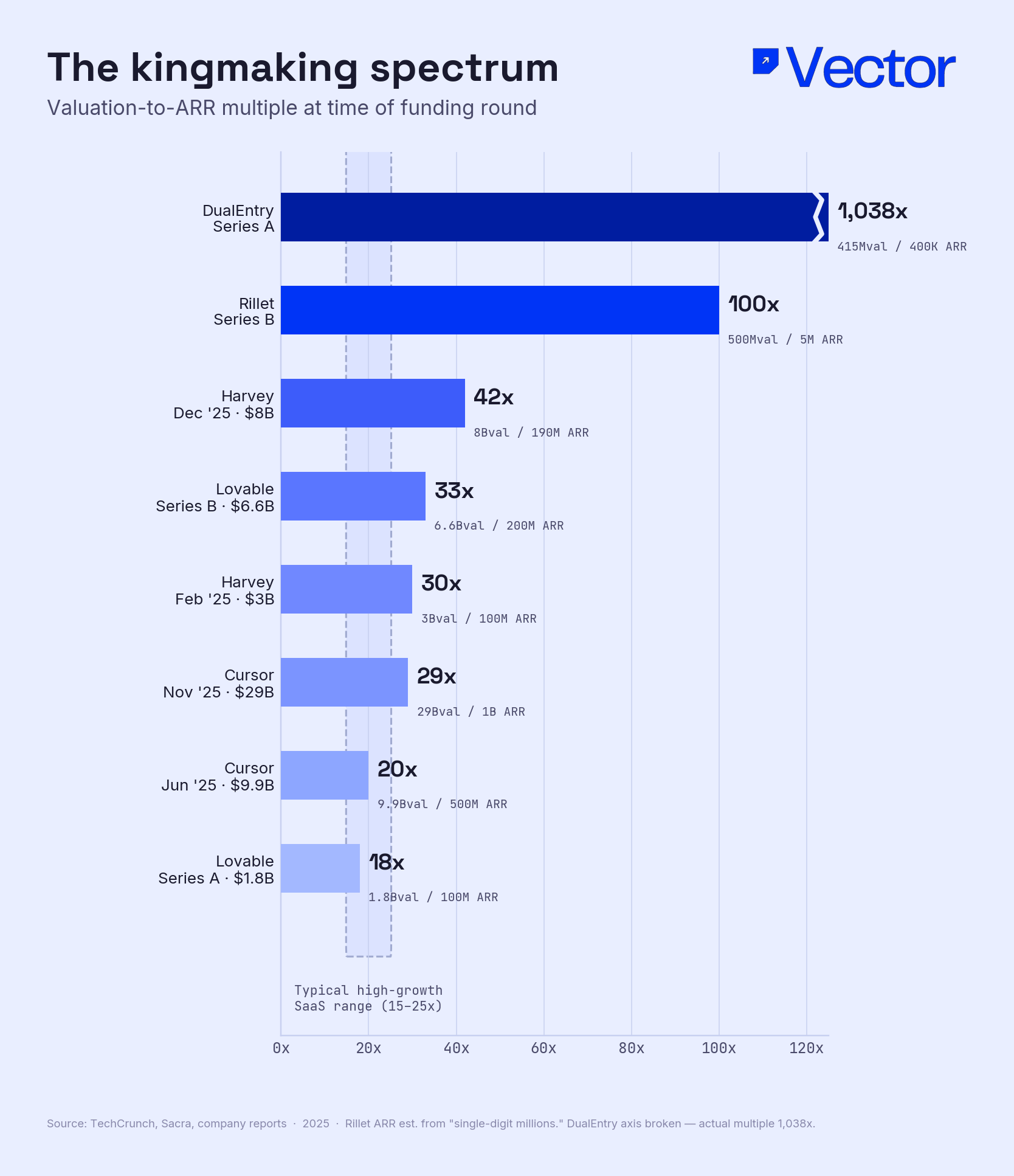
The macro numbers make the pattern legible at scale. OECD data shows that AI firms captured 61 percent of all global venture capital in 2025, or roughly $259 billion out of $427 billion deployed. According to Crunchbase, five companies alone — OpenAI, Scale AI, Anthropic, Project Prometheus, and xAI — absorbed $84 billion, a fifth of all venture funding for the year. Mega-rounds of $500 million or more accounted for over 30 percent of total capital deployed in the third quarter, with just 18 companies securing a third of all dollars. Capital is not merely concentrating; it is crystallizing around a small number of bets made with conviction that borders on the metaphysical.
This article is for Vector members. Start a 7-day free trial to keep reading.
Start your free trial