Elon Musk bought the bottleneck for himself
Six days before SpaceX filed to go public, its founder personally bought one of the world's largest turbine fleets
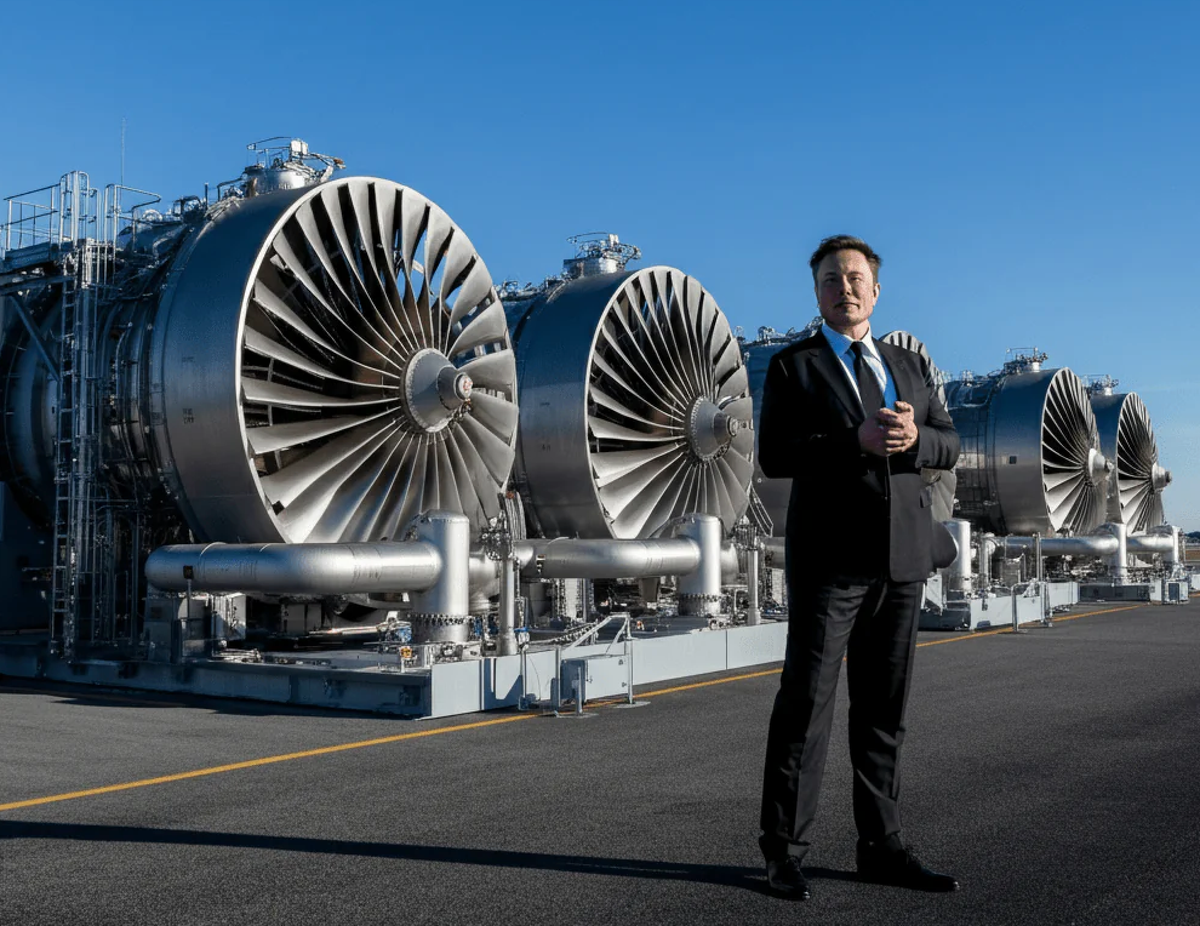
Elon Musk spent roughly a billion dollars of his own money on gas turbines this spring and, untrue to form, did not announce it. The Federal Trade Commission cleared the purchase on May 14th, publishing the notice in the routine feed of early-termination filings that antitrust lawyers scan and most of the financial press does not, where it sat unreported for two months. He bought it the way one buys a boat, and told about as many people.
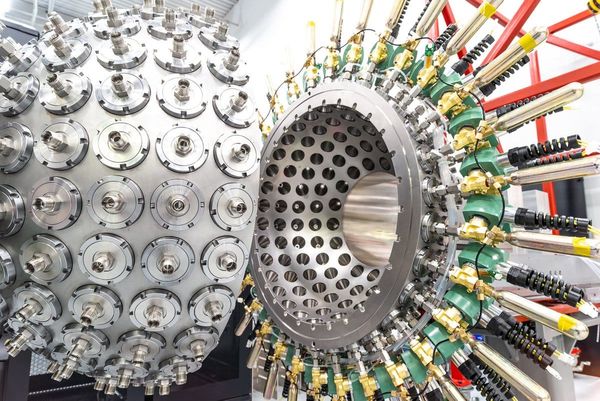
The turbines arrive on flatbeds. They are craned down, bolted to a pad, plumbed into a gas line, and running at full power in under ten minutes — a power station assembled in a parking lot in rather less time than it takes a utility to schedule the meeting about the interconnection study. New APR Energy, the Jacksonville outfit Musk bought, sells nothing but that gap. Thirty to ninety days, against the two to five years a permitted fixed plant demands. In January the company pushed its fleet past 1.1 gigawatts and said so out loud, crediting data-center demand, which was less a press release than a price list. Some 75 data-center projects worth $130bn were shelved across America in a single week this summer for want of power, not chips.
Nobody has proved that point harder than Musk. Colossus, the flagship, went up inside a dead Electrolux plant in the Boxtown neighborhood of South Memphis, and SpaceX tells investors it brought the first cluster online in 122 days — 91 for Colossus II — against an industry benchmark of roughly two years for a 100-megawatt greenfield site. The prospectus offers that compression, correctly, as the thing rivals cannot copy. It came from refusing to wait for the grid, which you can do only if somebody will drop turbines on your land inside a quarter. The AI segment burned $12.7bn on infrastructure last year and $7.7bn more in the first quarter of 2026 alone, against quarterly revenue that moved by $18m. Speed is very nearly the whole return on that capital. Turbines are what speed is made of.
Six days after the FTC cleared the purchase, on May 20th, Space Exploration Technologies Corp. filed its S-1. The risk factors concede that scaling the AI business depends on getting power. And deep in the document, in the passage explaining why a rocket company is now making chips with Tesla and Intel, the argument sharpens into a line that reads like a threat: the constraints on AI are physical, and "the future of AI will be determined by the control of the physical stack."
Behind the meter
Set aside the hypocrisy story. That a man who made his fortune on solar panels has bought a fossil-fuel company is embarrassing, and it is the least interesting thing on the page; Musk has been running gas turbines at Memphis for two years and defending them in federal court, and nobody following the Colossus buildout learned anything this week about his energy preferences.

The ownership is the story. Under the premerger rules the notice names the ultimate parent behind a deal — which is why it would read SpaceX or Tesla had either done the buying, and why a man acquiring in his own capacity is his own ultimate parent. Transaction 20261350 gives the acquiring party as Elon Musk. SpaceX swallowed xAI on February 2nd, in a deal its accountants booked as a reshuffle between entities under common control, and carried Colossus and Colossus II to the public markets in May: a gigawatt of compute, and a business that cannot grow without electrons nobody can currently get. Shareholders own that hunger. They do not own the fleet that can arrive in thirty days and feed it. One man does, and he is also the chief executive, the chief technical officer, the chairman, and the holder of a stock class carrying ten votes a share and the right to seat a majority of the board.
Whether the fleet already feeds the cluster is the question the filings decline to answer. Buried in APR's January announcement is a sentence nobody has picked up: the company was then supplying 375 megawatts to one of the world's largest AI data centers. It would not say which. It would not say a year earlier either, when it put four turbines and more than 100 megawatts of behind-the-meter power into an unnamed American hyperscaler. Musk has called the Memphis complex the largest AI training cluster in the world more times than anyone can count. Neither company will connect the two sentences.
Chuck Ferry has been in the fast-power business for decades, and he is currently in it twice. When APR fed that first hyperscaler, Ferry called it "a good proof point for our investment thesis" and promised more deals shortly — the satisfied noise of a man who has read the queue and priced it. He runs New APR Energy, which Fortress Investment Group assembled only recently out of the carcass of the original APR, an Atlas Corporation subsidiary, in a deal closed on the last day of 2024. He also runs Duos Technologies Group, the listed Jacksonville firm that helps operate the fleet, held 5% of it, and disclosed in June that it had banked roughly $50.4m in net proceeds. That disclosure is the only reason anyone knows what Musk paid. The man who sold the turbines and the man who told the market what they went for are the same man.
In April the NAACP sued, represented by the Southern Environmental Law Center and Earthjustice, over units running at Southaven without air permits. The complaint points at the concrete poured underneath them: whatever the filings call temporary, somebody laid a foundation. In June the Justice Department asked the court to throw the case out, on the ground that Grok is mission-critical to national security and the turbines therefore cannot be switched off. The government's position, in short, is that the republic depends on a chatbot, and the chatbot depends on some trailers.
There is a defense here, and it is not a weak one. A corporate acquisition needs a board, a process, a disclosure decision and a calendar; a man with a checkbook needs a week. If turbines are the binding constraint on a gigawatt of compute and Fortress was selling, buying personally may have been the only structure quick enough to matter — and a controlling shareholder staking $1bn of his own money on his company's chokepoint, rather than the shareholders', is an argument that has been made in his favor before. It was made in 2016, when Tesla bought SolarCity for $2.1bn. Musk chaired SolarCity's board, held large stakes in both, recused himself from the vote, and was sued in Delaware by Tesla shareholders who said he had served himself at their expense. He won. A Delaware court cleared him in 2022, and the deal his critics called self-dealing looks, a decade on, like the vertical integration he always said it was.
Speed explains the buyer. It does not explain the quiet. SolarCity was announced, fought over in public for four months, and voted through by 85% of Tesla's shareholders — which is precisely why it survived the courtroom. The turbines were bought in May and surfaced by another company's filing in June, six weeks before a reporter noticed the form.
Page 243 of the prospectus is where SpaceX catalogues what it calls transactions with Elon Musk and affiliated entities, and it is a fastidious document. It records that Musk serves as Tesla's Technoking. It records that SpaceX invoiced Tesla $2m last year for flying him around in its aircraft, and that X pays a Boring Company subsidiary a hundred thousand dollars a year for its office space. It records that xAI took $506m of goods and services from Tesla in 2025, most of it batteries. And under a heading of its own sits Musk Industries LLC, a company Musk owns outright, from which xAI rents a piece of real property. It paid him $2m for it last year.
The structure, then, is not novel. It is house practice, itemised to the decimal, down to the plane tickets. The turbines are not there, and they are not anywhere else in the document — search three hundred pages for the company Musk bought and nothing comes back. There may be good reasons for that. The related-party tables close on February 28th, ten weeks before the FTC cleared the deal, and Musk bought the fleet from Fortress rather than from SpaceX, which makes it a transaction the company was not party to and had no plain duty to announce. The prospectus can reach into May when it chooses; it discloses a compute agreement with Anthropic signed that month, worth $1.25bn a month through 2029. But a deal the company signs and a purchase its founder makes are different animals, and only one of them is the company's to report.
That reporting comes due later, in a filing that does not yet exist. Should the fleet sell power into Colossus, it becomes a transaction between a public company and an entity its controlling shareholder owns outright — precisely what page 243 exists to catalogue. A building got Musk Industries a heading and a line item of its own. The next filing will show what a gigawatt gets.