Google's best AI bet was on a rival
Alphabet's Anthropic stake is its most valuable holding, and it carries no board seat, no votes and no control
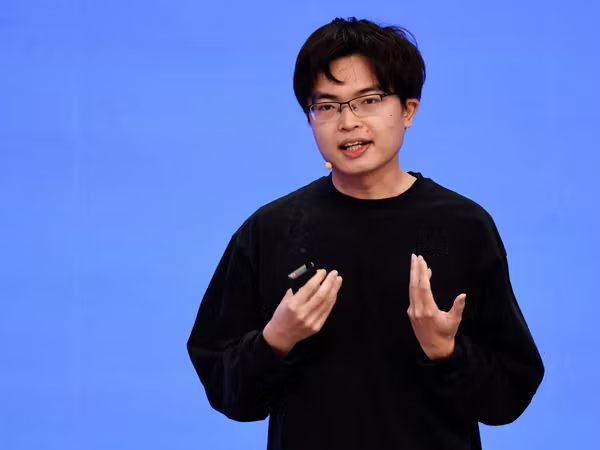
IN THE SPRING of 2021, Dario Amodei and a group of colleagues left OpenAI over disagreements about the direction of the company and founded their own laboratory. Five years later, Alphabet disclosed that its holdings in private companies had reached a fair value of $124.3 billion, consisting primarily of one investment it declined to name. The unnamed company is Anthropic, the laboratory Amodei built, and it is now the most valuable position Alphabet holds outside its own operations. Google has no seat on its board, no observer rights, and no votes.
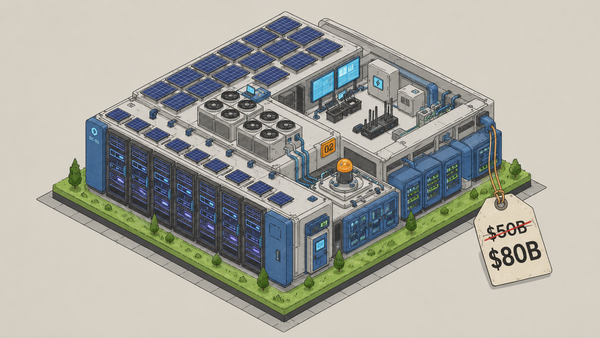
The quarter Alphabet reported on Wednesday was, by the headline number, the best in the company's history. Net income reached $112.1 billion, up 298% from a year earlier, and of the $9.11 the company earned per diluted share, $6.26 came from revaluing securities it has not sold. Strip that out and the figure is $2.85. Alphabet does not disclose which holdings produced the gain, and the portfolio includes SpaceX as well as Anthropic; Bank of America, in a note published before the release, modeled the Anthropic markup alone at close to $80 billion before tax. However the number divides, twenty years of advertising infrastructure and the fastest-growing cloud business in the industry together produced the smaller share of the profit.

Google put $300 million into Anthropic in 2023 for roughly a tenth of the company, followed within months by $2 billion more, and against a little over $3 billion the current mark looks like one of the great venture returns of the era. That version leaves out the money that actually built the position. In April Google agreed to invest as much as $40 billion further, beginning with $10 billion at a $350 billion valuation, and Thursday's filing indicates another $10 billion went in during the June quarter. Something close to $20 billion of Google's roughly $23 billion cost has been spent in the past four months, at prices set on the way up.
Fair value judgments
What the money bought is a position with no steering wheel attached. Court filings in the government's antitrust case against Google put its holding at 14% before this year's dilution, against a contractual ceiling of 15%, and record the governance rights attached to it as none. Amodei left one laboratory over what corporate influence does to a research organization and now runs the most heavily corporate-financed research organization ever assembled, on terms that keep every one of its backers out of the room. Claude competes with Gemini for the same enterprise contracts. Google's most valuable holding is a company actively trying to beat its flagship product.
There is a precedent, and it is instructive rather than reassuring. Two days before Christmas in 1982, IBM paid $250 million for 12% of Intel at $40 a share, with the agreement permitting a stake as large as 30%. IBM was Intel's biggest customer, accounting for roughly 15% of its business, and a spokesman explained the purchase as an interest in keeping a strong merchant semiconductor industry alive. It built the holding toward 20%, began looking for buyers in 1986, and let Intel repurchase 8.9 million shares for $361.6 million the following year, retaining a diminished position it continued to sell down. IBM had identified the most important company of the coming era and financed it. The chips it helped underwrite went into machines that took its market apart.
The reason to buy anyway has never been the equity. Anthropic has contracted to secure up to five gigawatts of Amazon's Trainium chips, and Google's $40 billion arrived alongside a substantial expansion of Anthropic's capacity on Google's own silicon. The frontier laboratories are the largest consumers of computing power ever assembled, and the companies building that power have concluded that owning a piece of the customer is cheaper than losing them. Alphabet is spending between $195 billion and $205 billion this year. Twenty billion dollars to anchor a decade of demand against it is a rounding error with a lottery ticket stapled to the front.
None of which produces money the holders can use. Alphabet's record quarter carried free cash flow of negative $5.9 billion, and the market answered the largest profit in company history by selling the stock down more than 6%. The company has already watched what happens when one of these positions meets an actual buyer. SpaceX listed on the Nasdaq on June 12th, closed its first session near $161 and touched a valuation of roughly $2.1 trillion intraday, and Google's stake was marked at $94.1 billion on June 30th. By Thursday the shares traded near $118. Eighty billion dollars of the position sits under short-term sale restrictions, with a further $14.1 billion locked into the third quarter of 2027.
Anthropic's bankers at Morgan Stanley, Goldman Sachs and JPMorgan are arranging investor meetings for a listing that could price as soon as October, at a valuation the street expects to open above $1 trillion. It will be the first time a public market has been asked what a frontier laboratory is worth. Google will not be able to sell into the answer for some months after it arrives. IBM, holding the same kind of position in 1986, could sell whenever it liked, and did.