How much do AI data centers actually cost?
The market prices a multitrillion-dollar buildout off a $50B-per-gigawatt figure it treats as fixed — and that figure has roughly tripled in 18 months
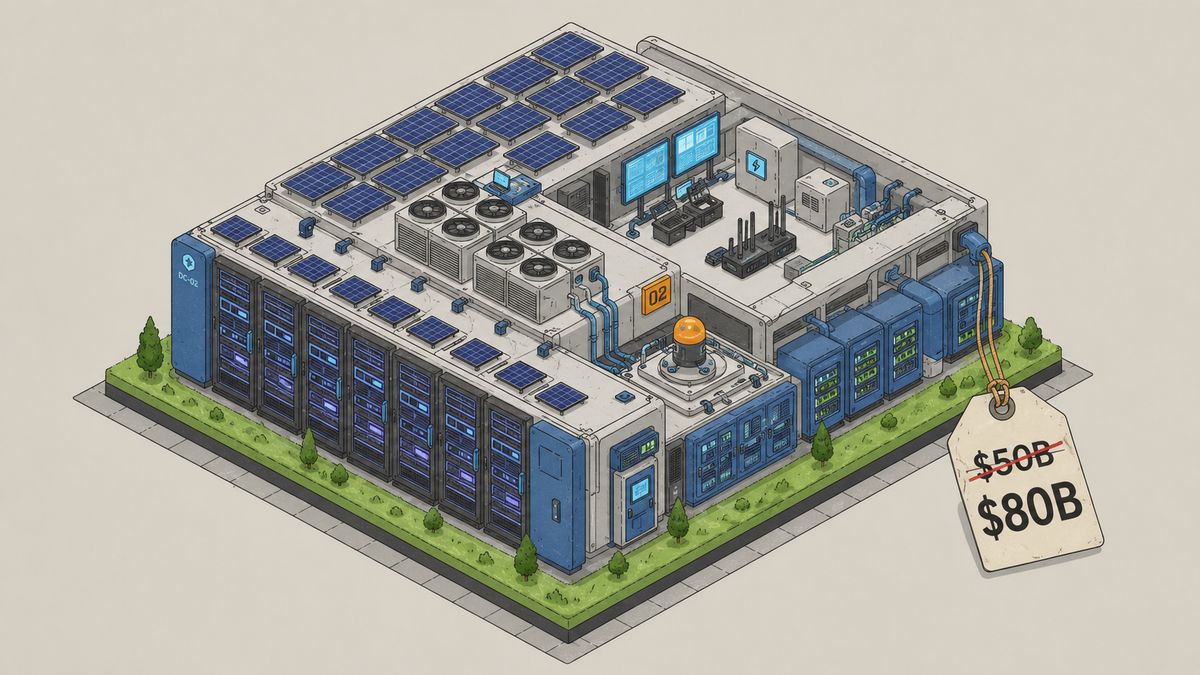
AT GTC TAIPEI IN LATE May, Jensen Huang, Nvidia's co-founder and chief executive, walked an audience through the biography of a number. An AI "factory" of one gigawatt, he said, used to cost $20bn-30bn to build; it now runs $50bn-60bn; and it would soon reach $80bn-100bn. He offered the figures the way one might mention the weather — an aside en route to a bullish point about demand. They were duly reported as good news for Nvidia. Fewer noticed that he had, in passing, tripled the single number the entire industry uses to price the artificial-intelligence boom.
That number — the cost per gigawatt — is the hinge on which the sector's trillion-dollar arithmetic turns. Analysts multiply it by forecast demand to size the market; reporters cite it as settled fact. McKinsey, a consultancy, reckons the world will need 156 gigawatts of AI data-centre capacity by 2030 and some $5.2trn to build it — a figure that, run backwards, implies a build cost of about $33bn a gigawatt. Barclays, a bank whose AI-capacity tracker runs on the number, uses $50bn-60bn. Multiply McKinsey's gigawatts by Mr Huang's rate of the moment and you reach the "$6trn opportunity" now doing the rounds. Everyone works from the same equation. They simply disagree, by a factor of three, about one of its terms.
Constant gardening
The trouble is that the term is not a constant at all. It is the most elastic input in the stack, and it moves in one direction. The chips grow denser and hungrier each cycle — Nvidia's flagship silicon has climbed from 700 watts of thermal design power on its H100 to some 2,300 on the coming Vera Rubin, its next architecture — and denser silicon demands costlier everything around it. On July 21st TSMC, the Taiwanese firm that fabricates Nvidia's chips, told customers it would raise wafer prices by up to 10% from 2027, with a further 10-15% on the high-performance orders that run above contracted volume, to offset its own rising materials and construction costs (so Nikkei, a Japanese outlet, reported; TSMC, as a matter of policy, declines to confirm pricing). A wafer is a slice of a GPU, which is a slice of a build. But the slices are repricing at once — and the least glamorous of them fastest. Prices for the large transformers that move grid power have risen roughly 77% since 2019; lead times that ran about a year in 2020 now stretch to four. GE Vernova, a power-equipment maker, has booked more than 100 gigawatts of gas-turbine orders, some slotted into the next decade; switchgear is sold out through 2028. Electrical gear is under a tenth of a data centre's cost and close to the whole of its bottleneck. When the scarce input reprices, the constant reprices with it.
This article is for Vector members. Start a 7-day free trial to keep reading.
Start your free trial