Why aren't the Navy's robot ships clearing the Strait of Hormuz?
Task Force 59's four years of unmanned innovation in the Persian Gulf, and the Strait of Hormuz is still a kill box
THE STRAIT OF HORMUZ is twenty-one miles wide at its narrowest point, fringed by Iranian missile batteries, and — as of mid-March 2026 — functionally closed. Since the IRGC declared the waterway shut on March 2, tanker traffic has collapsed to near zero, more than 150 vessels sit at anchor in the open Gulf, and Brent crude has surged past $100 a barrel from a pre-war price of roughly $65. Some 20% of the world's daily oil supply is bottled up behind what analysts at the Center for Naval Analyses are calling an Iranian "kill box." The disruption, according to the International Energy Agency, is the largest in the history of the global oil market.
What makes this crisis especially galling is that the U.S. Navy spent more than four years preparing for something quite like it — and appears to have left the preparation on the shelf. In September 2021, Naval Forces Central Command stood up Task Force 59, a fledgling unit based in Bahrain with an explicit mandate to integrate unmanned aerial, surface, and subsurface systems into 5th Fleet operations across precisely this battlespace. TF59 reached full operational capability by January 2023. It tested some fifteen types of drones, accumulated over 55,000 operating hours, and participated in more than thirty multilateral exercises and six operational deployments around the Arabian Peninsula. Its crowning achievement: a complex manned-unmanned teaming operation conducted in the Strait of Hormuz itself. By December 2025 — just weeks before war broke out — TF59 had overseen the Navy's first-ever launch of a one-way attack drone, the LUCAS system, from a surface combatant in the Arabian Gulf. A dedicated drone strike squadron, Task Force Scorpion Strike, was deployed to the Middle East that same month.
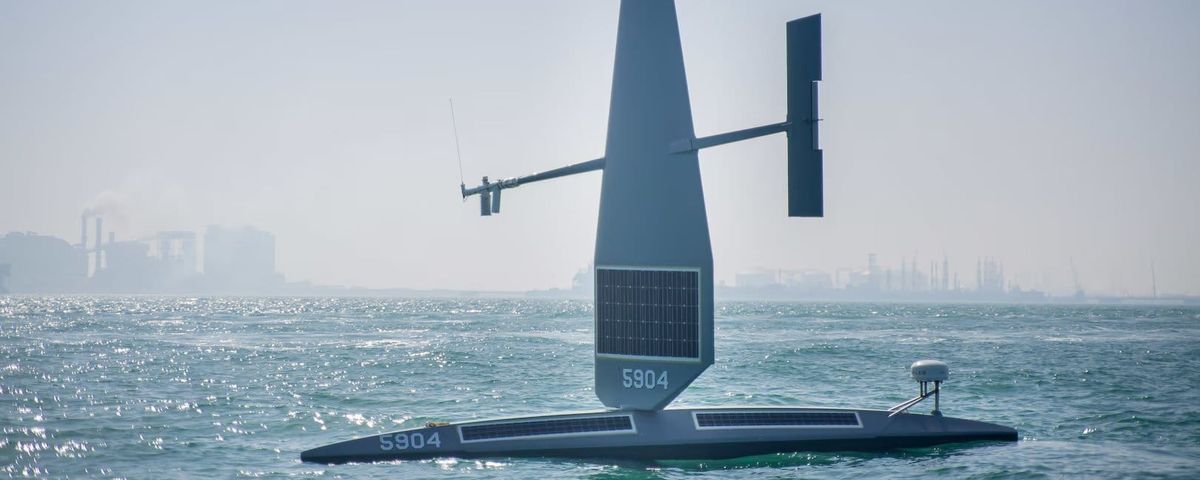
The startups were there, too. Saildrone, a San Francisco-based company that builds wind-and-solar-powered unmanned surface vessels, has been embedded with TF59 since its inception. Its 23-foot Explorer drone — essentially a tall-winged ocean sailboat bristling with cameras, radar, and AIS transceivers — can stay at sea for up to twelve months without refueling, beaming surveillance data back to shore via satellite. One guided-missile destroyer costs roughly the same as 2,000 Saildrones; the economics of persistent maritime awareness, on paper, are overwhelming. Iranian forces twice attempted to capture Saildrone vessels in the Persian Gulf — a backhanded compliment to their operational value. The company also developed GPS-denial countermeasures after hostile actors tried to jam and spoof its vessels in the Red Sea. Beneath the surface, Palmer Luckey's Anduril Industries has been building what may be the most consequential unmanned naval platform of the decade: the Ghost Shark, an extra-large autonomous underwater vehicle developed with Australia's Defence Science and Technology Group. The Royal Australian Navy took delivery of its first production unit in January 2026 under a A$1.7 billion contract; days ago, on March 13, the Defense Innovation Unit and U.S. Navy selected Anduril's Dive-XL — Ghost Shark's commercial cousin — for the Combat Autonomous Maritime Platform project, a programme aimed at fielding long-range robotic submarines capable of mine detection, undersea surveillance, and operating in GPS-denied environments. Anduril's autonomous undersea vehicles have already logged more than 42,000 kilometers and 6,700 hours of mission time. The platforms exist. The production lines exist. The operational need is staring at the Navy from the front page.
This article is for Vector members. Start a 7-day free trial to keep reading.
Start your free trial