Anduril builds the aircraft nobody ordered
Archer and Anduril unveiled a military rotorcraft on Monday for a program the Pentagon has not created
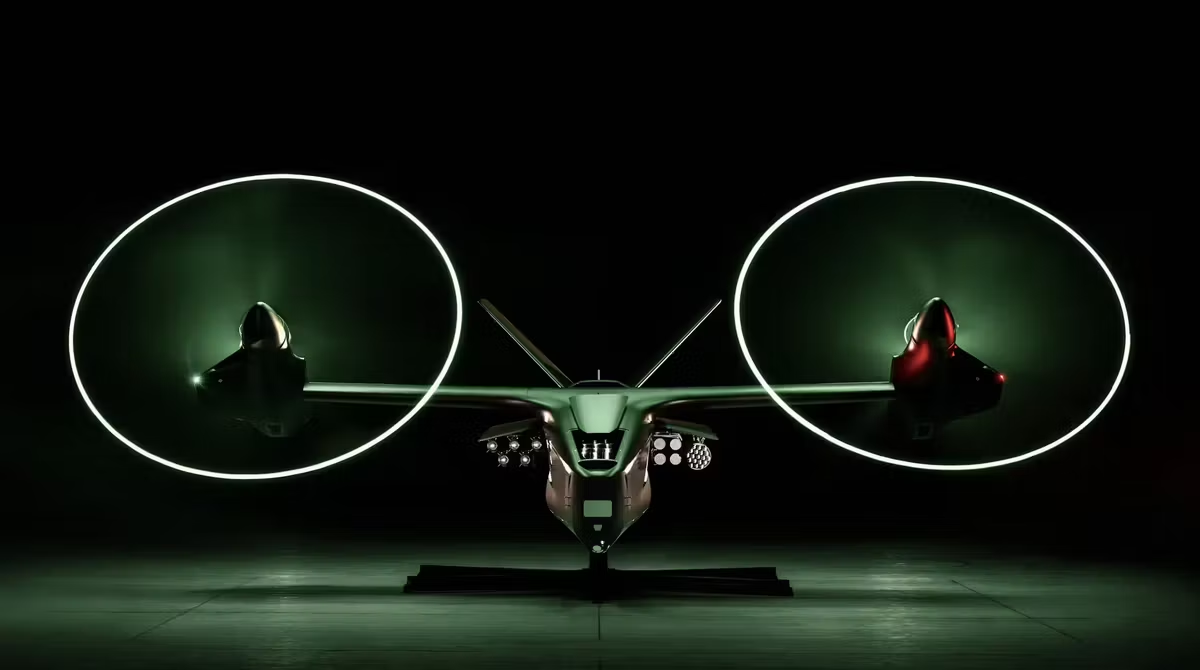
Thunder, the autonomous attack rotorcraft that Archer Aviation, a maker of electric air taxis, and Anduril, a defense-technology company, showed at the Farnborough air show, is a Group 5 machine — the heaviest class of drone — built to fly beside the Apache gunships and armed scout helicopters the American army no longer has. It is a finished design, pointed at a first flight in 2027. What it is not pointed at is a competition. No program of record defines it, no request for proposals invites it, no line in the budget carries its name. Archer and Anduril built it anyway.
Much of Monday's coverage framed the reveal as a rescue. Archer, like the rest of the electric-vertical-takeoff business, has watched the trillion-dollar urban air-taxi market it was promised recede behind certification delays, thin ground infrastructure and steep capital needs; for a company burning cash toward an aircraft regulators have not yet cleared, a defense program is ballast. That is a fair account of Archer. It explains almost nothing about Anduril, which agreed to co-develop an attack aircraft for a customer that has issued no requirement for one.
Spec work
Anduril has run this way since Palmer Luckey, its co-founder, started the company in 2017. A legacy prime, whether Lockheed Martin, RTX or Northrop Grumman, waits for the government to write a requirement, publish a request for proposals, and fund the work on a cost-plus basis, an arrangement that reimburses whatever the job ends up costing and so rewards no one for finishing early or cheap. Anduril runs the sequence backwards. It spends its own money, and its investors', building systems it expects the Department of War to want, then sells them finished at a fixed price. Adam Goldstein, Archer's chief executive, described the logic in nearly the same terms, telling Reuters that Anduril has grown adept at spotting needs and building against them before any program is announced. The two companies, he said, "built a very specific aircraft for that need."
The wager looks shrewdest where the government has failed most visibly. Shane Arnott, Anduril's senior vice-president for programs and engineering, said Thunder is meant for every operator of Apaches and armed reconnaissance helicopters — which is to say for a mission the army has spent two decades and more than $11 billion trying, and failing, to field a purpose-built aircraft for. The RAH-66 Comanche died in 2004 after some $9 billion. The Armed Reconnaissance Helicopter followed it into cancellation, then the Armed Aerial Scout competition. In February 2024 the army killed its most recent attempt, the Future Attack Reconnaissance Aircraft, after sinking more than $2 billion into it, and declared that drones paired with the aging Apache would cover the gap. Its own aviation generals have since acknowledged, on the record, that the gap is still open.
That record is the argument for Anduril's model, stated in the negative. A requirements process that has produced four dead programs and one unfilled mission is not obviously better at deciding what to build than a company prepared to back a guess with its own balance sheet. Anduril's bet is that it can settle the requirement faster by building the answer than the Pentagon can by writing the question.
It has run the play before, and won. Anduril made its name on small, cheap, attritable things: counter-drone systems, surveillance towers, loitering munitions. Fury, the jet-powered fighter drone it flew for the first time last October, is a heavier animal, and it arrived by the same route. The airframe began as a privately funded aggressor design at Blue Force Technologies, a North Carolina startup Anduril bought in 2023; with a mature aircraft already in hand, the company took it into the Air Force's Collaborative Combat Aircraft contest and, in April 2024, beat Boeing, Lockheed Martin and Northrop Grumman for one of two development slots. It reached first flight 556 days after the contract award, faster, by Anduril's reckoning, than any modern fighter program. With Thunder, Anduril is running the same play a step earlier still, building the aircraft before any competition exists to enter it.
The economics reward the nerve. Because it funds development privately and sells at a firm fixed price, Anduril books gross margins that analysts estimate at 40 to 45%, several times the 8-to-12% that cost-plus work leaves the traditional primes. A fixed-price order for a product that already exists is a different instrument from a cost-plus contract to invent one: the first buys a finished good, the second underwrites an attempt. And the model has shown it scales. In March the army folded more than 120 separate procurement actions into a single firm-fixed-price enterprise agreement with Anduril worth up to $20 billion over ten years, not a bespoke development program but a standing order for products the company had already built.
None of this makes the bet a sure thing. A requirement the government has not written can be written to fit someone else, or never written at all; Congress funds the primes' production lines across a great many districts, and those firms have spent a century turning capability gaps into programs shaped to the tooling they already own. Thunder is a year from its first flight, and the survivability doubts that helped end FARA (that a crewed scout cannot last in contested airspace) will be pressed on an uncrewed one too, with less flight data so far to answer them. Anduril's protection is that it spread the risk: Archer carried much of the airframe work and the capital, so Anduril's downside is a written-off program rather than a solvency event.
The army spent two decades deciding what to buy and never decided. Anduril decided for it. When Thunder lifts off in 2027 the aircraft will be real, finished and priced, whether or not a program of record exists to receive it. The requirement can catch up.