NVIDIA hedges against its own data centers
The data center made Nvidia the most valuable company on earth — the RTX Spark insures against losing it
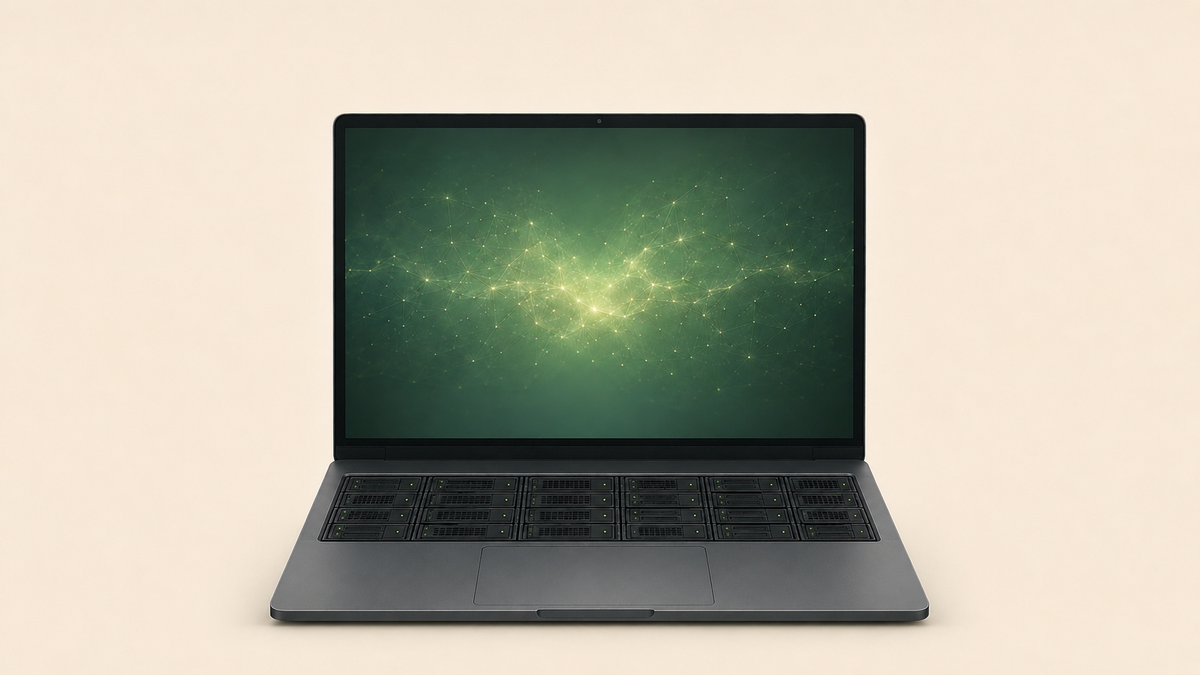
JENSEN HUANG, Nvidia's chief executive, told a Computex audience in Taipei on Monday that his company was reimagining the personal computer "for the first time in 40 years." The arithmetic rewards a pause. Four decades ago the personal computer was only beginning to win its argument with the mainframe; most people who used a computer at work still reached their share of one through a terminal wired to a machine in another room, renting slices of a processor they would never see or own. The promise of the PC was emancipation from that arrangement — the machine on the desk, the compute in the box, the humming room down the hall made obsolete.
The room came back, as it always does. Within twenty years cloud computing had pulled the processing off the desk and into data centers reachable over a broadband line; software became something one visited rather than installed; the capable laptop was demoted to a window onto a machine somewhere else. Generative AI then completed the reversal in its purest form. When a user prompts ChatGPT or Claude, the work happens inside a building full of Nvidia chips hundreds of miles away, and the device in front of them does little more than draw the reply on a screen. The dumb terminal never died; it learned to talk.
Terminal velocity
The RTX Spark Superchip, which Mr Huang unveiled on Monday, is a wager that the pendulum is about to swing back toward the desk. The chip pairs a Blackwell graphics core with a 20-core Grace processor — an Arm-based design Nvidia developed with MediaTek, a Taiwanese chip firm, and built by TSMC — and amounts to a consumer repackaging of the Grace Blackwell superchip the company already ships in its DGX desktop machines. Nvidia calls it "the most efficient PC chip ever built," a claim Mr Huang paired with a more interesting one: that the machine can run a 120-billion-parameter language model locally, on a laptop, without reaching for the cloud. Devices from Dell, HP, Asus, Lenovo, MSI and Microsoft's own Surface line are due this autumn, aimed first at a premium tier of developers, creators and gamers, with some 30 laptops and more than ten desktops promised behind them. The interface, in Mr Huang's telling, is the real change: agents that act across applications with minimal supervision, displacing the mouse and keyboard that have governed computing since — as it happens — about 40 years ago.
This article is for Vector members. Start a 7-day free trial to keep reading.
Start your free trial