The moat you can't buy
OpenAI spent $6.5 billion buying its way into hardware — Apple's suit argues the knowledge it wanted still had to be taken
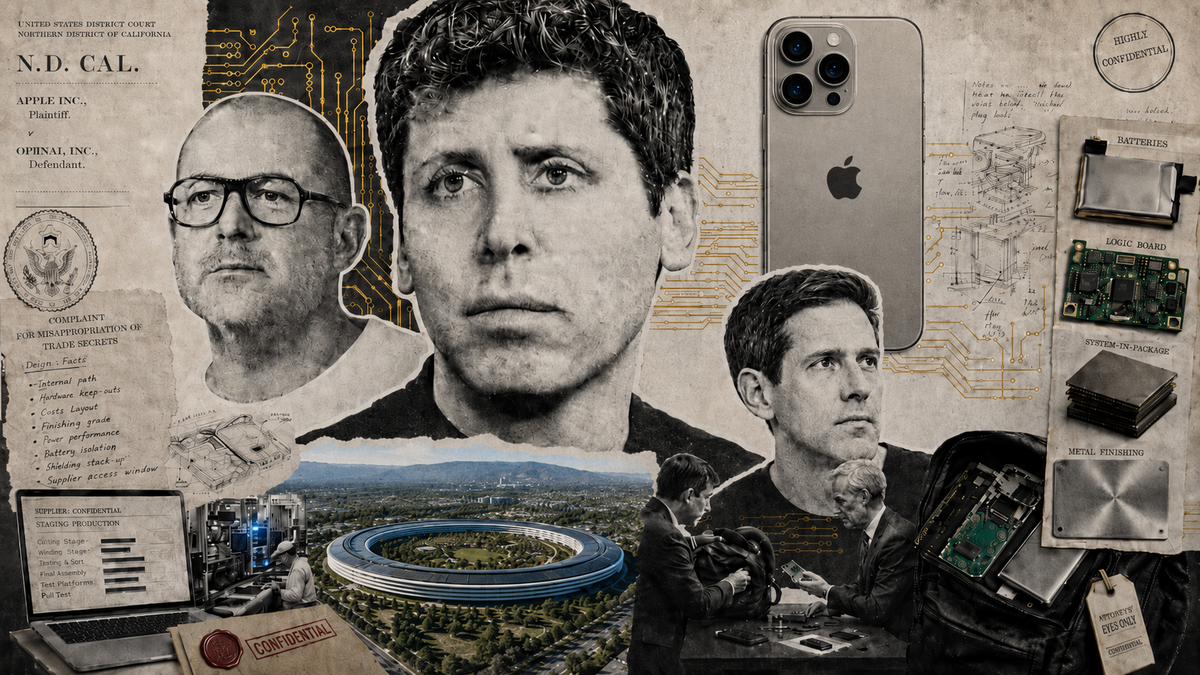
According to the complaint Apple filed on July 10th in the Northern District of California, the instruction to job candidates was unusually specific: bring the actual parts. Batteries, logic boards, the system-in-package modules that take years to tune. Tang Tan, OpenAI's chief hardware officer and a former Apple design executive, allegedly asked Apple employees interviewing for jobs at OpenAI to carry the physical components in for "show and tell."
The suit names OpenAI, its hardware unit io Products, Mr Tan, and Chang Liu, a former Apple systems electrical engineer who spent eight years at the company before leaving in January. Apple accuses them of a coordinated effort to lift its confidential hardware knowledge, from product designs to manufacturing processes to supply-chain strategy, in order to speed OpenAI's push into consumer devices. Jony Ive, Apple's former design chief, whose startup OpenAI bought last year, is not named. Everything in the filing is, for now, an allegation, and OpenAI says it has "no interest in other companies' trade secrets."
Some assembly required
What the specifics describe is a company discovering that hardware capability cannot be bought the way software talent can. OpenAI spent $6.5 billion last year to acquire io, the design studio Mr Ive founded with a cohort of Apple alumni, and it has hired more than 400 former Apple employees besides. That is an enormous amount of capital and pedigree pointed at a single problem. The complaint's argument is that it was not enough: even after buying the designers and the vision, OpenAI still needed the parts.
The knowledge that makes a consumer device work is unlike the knowledge that makes a model work. A frontier lab's advantage lives in weights, data, and research talent, all of which are portable; a researcher can carry the important parts of it across the street in her head, which is why the labs poach each other so freely and why the poaching mostly works. Hardware capability is embodied differently. It lives in manufacturing tolerances refined over a decade, in the specific way a metal housing is finished, in supplier relationships and tooling and yield curves and the accumulated scar tissue of shipping a billion units. Apple alleges that OpenAI, through a partner, used a proprietary metal-finishing technique after misleading the supplier into believing it had Apple's blessing. Metal finishing is precisely the sort of thing that does not appear in a slide deck. It is learned by doing, at scale, for years.
Not everything Apple describes is so intangible. Mr Liu allegedly kept his Apple laptop after leaving and used a security flaw to keep pulling confidential files from the company's servers for months, the copyable end of the theft, the part that leaves logs. The metal finishing and the parts are the harder end, the knowledge that moves only when a person carries it.
This is the shortcut the software industry keeps trying to take and keeps finding blocked. Google, with effectively unlimited resources, spent the better part of a decade and several abandoned product lines before its Pixel phones became credible hardware. Amazon's Fire Phone, launched in 2014 with the full weight of the company behind it, was discontinued about a year later. Microsoft sank years and billions into Windows Phone before giving up. The pattern is consistent enough to be a rule of thumb: capital and software talent, however abundant, do not compress the years that consumer hardware takes to learn.
That is also why the fight arrives in the language of trade secrets rather than contracts or patents. California, unusual among the big technology states, refuses to enforce non-compete agreements, so an incumbent cannot legally stop its engineers from walking to a rival. Trade-secret law is the fence that remains, the legal system's admission that some capability walks around inside people's heads and hands, and that the line between what an employee knows and what an employer owns is genuinely hard to draw. Apple says over 400 of its former staff now work at OpenAI. Each of them left with something no exit interview can claw back.
There is an irony in Apple bringing the suit at all. The company's entire defensibility, across two decades, has rested on the fact that its moat is embodied rather than codified, that what it knows about building objects cannot be easily copied because it does not exist in a copyable form. The lawsuit is Apple asserting exactly that thesis in court: that the knowledge is so specific, so hard-won, so resistant to transfer, that the only way OpenAI could have it this fast is to have taken it. If OpenAI's device turns out to be any good, Apple is arguing, the goodness is stolen, because there was no other way to get it in time.
OpenAI will contest that reading, and its recent record in court is strong; it beat back a suit from Elon Musk, an OpenAI co-founder, this spring, and saw a separate trade-secret claim from xAI, Mr Musk's AI company, dismissed in June. Read one way, the filings are what a talent war looks like from the losing side: companies that cannot stop their engineers from leaving reaching for the one legal tool California leaves them. Talent moving between rivals is how Silicon Valley has always worked, and a former employer's grievance is not the same as misappropriation. The relationship had already cooled well before the filing, with Apple folding rival models into a long-delayed Siri overhaul and OpenAI spending months weighing its own claims over how its ChatGPT integration had been buried. Discovery will decide whose version survives.
The shape of the complaint is the tell, whatever the verdict. A company that had genuinely cracked the problem would not need the parts. Apple spent roughly twenty years learning to turn aluminum and silicon into objects people carry everywhere; OpenAI spent $6.5 billion and change trying to buy the answer, and, if Apple is right, found that the answer would not fit inside the acquisition. Some of it had to come in a backpack, one interview at a time.